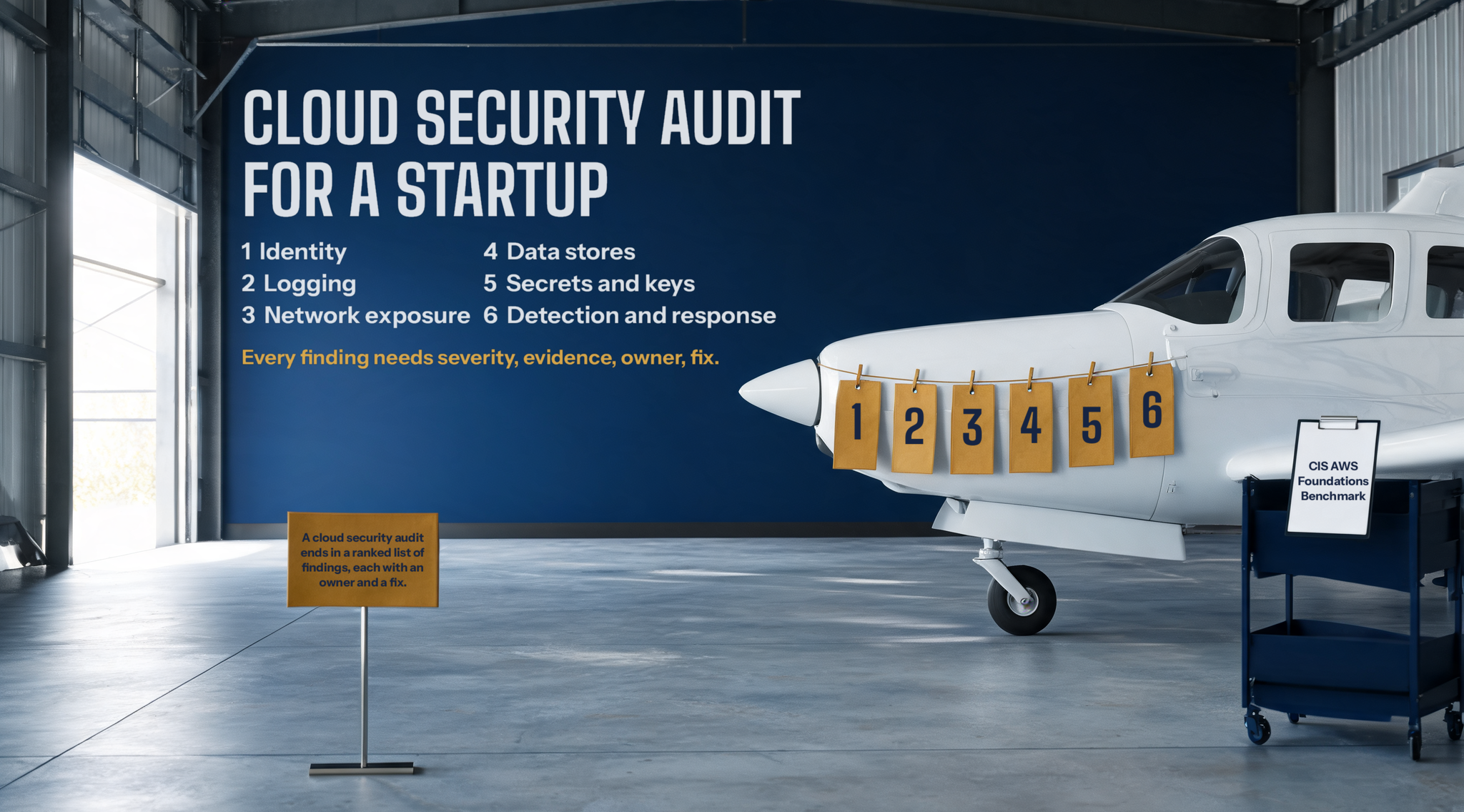
A cloud security audit for a startup is a time-boxed, evidence-based review of your cloud accounts against a named public benchmark, and it ends in a written list of findings ranked by severity, each with an owner and a fix. For a team of 5 to 30 engineers it covers six areas: identity, logging, network exposure, data stores, secrets and keys, and detection and response. It is not a certificate. It is the honest picture of where the account stands today, and the order in which to fix it.
This post is for the founder or first engineer who has been told "we should get a cloud security audit" by an investor, a customer's security team or their own unease, and who now has to decide what to buy. Most pages on the subject are a vendor's product page or a generic checklist with no sense of what matters first.
If the audit request came from a customer or investor security review you cannot fully answer yet, see how we work through a security questionnaire.
Three earlier posts cover narrower audits and are linked rather than repeated: the cloud cost audit covers spend, the AWS IAM audit walkthrough covers permissions only, and the Kubernetes security audit guide covers clusters. This one covers the whole account. Every factual claim below links to its public source, read in November 2026; anything else is labelled practitioner opinion.
Quick context: what a cloud security audit looks like in 2026
Two things changed the shape of the work. First, the benchmarks are public, versioned and maintained. The Center for Internet Security announced version 7.0.0 of the CIS Amazon Web Services Foundations Benchmark in its April 2026 benchmarks update, and version 5.0.0 of the CIS Google Cloud Platform Foundation Benchmark in its June 2026 update. An audit no longer has to invent its own checklist.
Second, much of the checking is automated and cheap. AWS Security Hub CSPM runs CIS checks natively, and it added support for v5.0.0 in October 2025. Open source scanners such as Prowler run hundreds of checks across AWS, Azure, Google Cloud and Kubernetes in an afternoon. So the scan is no longer the expensive part. The judgement is: which findings are real, which are exploitable in your architecture, and which to fix this week.
A small note on search: some buyers look for a local provider, with searches such as "cloud security audit newport beach". The audit itself runs on read-only console and API access, so the auditor's city matters less than their method, their independence and the report they hand you.
What is a cloud security audit
A cloud security audit is an independent review of how a cloud account is configured and operated, measured against a stated standard, that produces documented findings with evidence. Three things separate it from a scan or a chat. It names its benchmark, so findings can be checked. It shows evidence for each finding, so you can verify it. And it ranks findings by severity, so you know what to fix first.
It sits inside the provider's shared responsibility model: the provider secures the hardware and the managed service, and you secure everything you configure. An audit only ever examines your half. That is the half where small teams get hurt, because a default left open or a key left in a repo is a customer-side mistake, not a provider breach.
1. Identity and the root account
Every audit starts with who can do what, because identity is the control everything else depends on. The AWS Well-Architected security pillar lists "implement a strong identity foundation" as its first design principle, and the CIS benchmarks open with identity for the same reason.
The checks are concrete. Does the root user have MFA, and does it have access keys? AWS's root user best practices say to enable MFA and not to create root access keys. Are humans signing in through a single identity provider, or through long-lived IAM users with passwords? Which roles can be assumed from outside the organisation? IAM Access Analyzer reports resources shared with external principals, which turns a vague question into a list. Who still has administrator access after leaving the team or changing roles?
For a startup the usual pattern is accumulation, not malice: an admin role created for a contractor and never removed, a CI user with full access because it was quicker. The detailed walkthrough lives in the IAM audit post.
Takeaway: if the audit only had time for one area, it should be this one. Root MFA, no root keys, no orphaned admins.
2. Logging and traceability
The second question is whether you could reconstruct what happened after an incident. Without logs there is nothing to investigate, and nothing to show a customer who asks.
On AWS this starts with CloudTrail: is there a trail covering every region, ideally an organisation trail, and is it writing to a bucket that the people being logged cannot delete? An audit checks log file validation, retention, and whether anyone actually looks. "Enable traceability" is the second design principle on the same Well-Architected page.
The gaps found at small companies tend to be quiet ones. A trail exists but only in the home region, while someone experiments in another. Logs land in the same account an attacker would control. Retention was left at a default that expires before an incident would even be noticed.
Practitioner opinion: the real question is "if a key leaked last Tuesday, could we say what it did".
Takeaway: one multi-region trail, written to a locked bucket, with a retention period longer than your realistic time to detect.
3. Network exposure
Next, the audit maps what is reachable from the internet, because that is where opportunistic attacks start. The check is not "is there a firewall" but "which ports, on which resources, are open to the whole internet, and should they be".
The CIS AWS benchmark carries controls against security groups that allow administrative ports such as SSH and RDP from anywhere; Security Hub CSPM evaluates these as part of its CIS standard. A good audit goes past the security group to the path: a database in a public subnet, a load balancer forwarding to an admin panel, a forgotten test instance with a public address, a staging environment with production data and no authentication.
Active testing has its own rules. AWS lets customers run security tests against a list of services without prior approval under its penetration testing policy, and treats denial of service testing separately. An audit can recommend a penetration test; it should not quietly become one.
Takeaway: the audit should hand you a list of every internet-facing endpoint with a reason it is open, or a recommendation to close it.
4. Data stores and encryption
The fourth area is where your customers' data lives: object storage, databases, snapshots and backups. The two questions are who can read it, and whether it is protected at rest and in transit, which is the Well-Architected principle "protect data in transit and at rest".
Public object storage remains the headline risk, even though defaults have improved. S3 Block Public Access is now on by default for new buckets, but older buckets, bucket policies written by hand and cross-account grants still need checking. Database snapshots can be shared publicly or with other accounts. Backups may exist but never have been restored, which means nobody knows whether they work.
An audit should also name what configuration alone cannot show, such as production dumps on developer laptops, as risks even when out of scope.
Takeaway: every data store should have a known owner, a known reader list, encryption on, and a backup that someone has restored at least once.
5. Secrets, keys and the pipeline
The fifth area is the credentials that machines use: API keys, database passwords, cloud access keys and the CI/CD pipeline that holds most of them. A leaked key bypasses every control above it.
The checks: are long-lived cloud access keys in use where roles or federation would work? How old are they? Are secrets in a managed store, or in environment files and repository history? GitHub secret scanning detects known token formats in repositories, and an audit should check whether it, or an equivalent, is on. Does the pipeline deploy with a scoped role, or with an administrator key stored as a CI secret? Can a pull request from a fork reach production credentials?
Practitioner opinion: this is the area most often missed by a configuration-only scan, because the risk lives in Git history and pipeline settings rather than in the cloud account itself. Ask any auditor up front whether the repositories and pipelines are in scope.
Takeaway: no long-lived admin keys in CI, no secrets in Git history, and a rotation date on every key that remains.
6. Detection and response readiness
The sixth area asks whether you would notice an attack, and what you would do next. The Well-Architected pillar calls this "prepare for security events", and the NIST Cybersecurity Framework 2.0, published in February 2024, gives detection, response and recovery a function each, alongside a new Govern function for ownership and policy.
In a small account this is mostly about whether native detection is on and whether anyone reads it. Is a managed threat detection service such as GuardDuty enabled in every region you use? Do its findings and budget alerts go to a channel a human watches, or to an inbox nobody opens? Is there a written, one-page runbook for "a key has leaked" and "the site is down", with names on it? Has anyone practised it?
An audit measures the gap between detection that exists and detection that reaches a person. That gap is usually the finding.
Takeaway: detection switched on everywhere, routed to a named human, plus a one-page incident runbook.
7. The benchmark the audit measures against
A credible audit names its yardstick in the first page of the report. Without one, findings are opinions and cannot be rechecked later.
For AWS the usual choice is the CIS AWS Foundations Benchmark. The current CIS release is v7.0.0, per the April 2026 update, while Security Hub CSPM's automated standard supports v5.0.0 and earlier versions. That gap is normal, and a good report states which version each automated result comes from. Google Cloud has the CIS Google Cloud Platform Foundation Benchmark, at v5.0.0 per the June 2026 update. Azure has the CIS Microsoft Azure Foundations Benchmark and Microsoft's own cloud security benchmark.
For a broader control view, the Cloud Security Alliance's Cloud Controls Matrix covers cloud controls by domain and maps to other standards. Practitioner opinion: for a startup, CIS for the technical checks plus a short governance section is enough. A full control framework is for when a customer or regulator asks for one.
Takeaway: ask "which benchmark, which version" before you sign. Any answer other than a named, versioned standard is a warning.
8. What the report should contain
The report is the product. A scan export with 400 rows is not a report. Practitioner opinion, from what a small team can actually act on, a useful cloud security audit report contains:
- Scope and method: accounts, regions and repositories examined, the access used, the dates, and the benchmark and version.
- An executive summary of one page: the three to five findings that matter most, in plain language a founder can repeat to an investor.
- A findings register. Every finding needs severity, evidence, owner, fix. Severity can follow a public scale such as CVSS or a stated high, medium and low rule; evidence is a screenshot, a resource ARN or a command output; the owner is a named person; the fix is a concrete change.
- A risk matrix that plots likelihood against impact, so the order of work is visible.
- What was out of scope and what the auditor could not verify.
- A walkthrough where the auditor explains the findings to the people who will fix them.
The point of the register is that a cloud security audit ends in a ranked list of findings, each with an owner and a fix. A finding with no owner is a finding nobody will close.
Takeaway: ask to see a redacted sample report before you buy. If the sample is a raw scanner export, you are buying a scan.
9. Cloud security audit vs SOC 2, ISO 27001, CERT-In audit and penetration test
These five are often confused, and buying the wrong one costs months. The deciding question is what the result is for.
| Engagement | Who can perform it | What you get | Buy it when |
|---|
| Cloud security audit | Any competent independent reviewer | Ranked findings and fixes for your accounts | You want to know where you stand and what to fix first |
| SOC 2 report | Only a licensed CPA firm (CSA explainer) | An attestation report on controls, Type 1 or Type 2 | A customer requires a SOC 2 report |
| ISO/IEC 27001 certification | A certification body; ISO itself does not certify | A certificate for an information security management system | Customers, often in Europe or Asia, ask for ISO 27001 |
| CERT-In empanelled audit | An organisation on CERT-In's empanelled auditor list | An audit report from an empanelled Indian auditor | An Indian regulator, government buyer or contract requires one |
| Penetration test | Testers within the provider's testing policy | Proof of what an attacker could actually exploit | Your configuration is reasonable and you want it attacked |
Decision rule: an audit is how you find and rank the problems; attestation and certification are how you prove controls to someone else. A cloud security audit is a sensible first step before SOC 2 or ISO 27001, because it surfaces what an auditor would find. It never replaces them. The cost side of SOC 2 is in what SOC 2 costs an Indian startup, and the questionnaire side is in the security questionnaire post.
10. What it costs, and who should run it
Price is where most pages go vague, so here is what is actually published. MatrixGard publishes two audit tiers on its pricing page: a Free Audit, a 20 minute call that surfaces the top three issues verbally, and a Full Audit at $1,500, or ₹15,000 in India, which takes two days and delivers a written report with a risk matrix, severity ratings and a 60 minute walkthrough. The Full Audit is fully credited toward a first retainer month and carries a money-back guarantee on findings. Many other audit firms do not publish prices; ask any provider for a fixed quote tied to a written scope.
Who should run it depends on what you need. Your own engineer can run Prowler or Security Hub CSPM for free, and should, but cannot be independent of their own decisions. A security consultancy or fractional DevSecOps team gives an outside view and a report a customer will take seriously. A CPA firm, certification body or CERT-In empanelled auditor is only necessary when the result must be an attestation, a certificate or an empanelled report.
Practitioner opinion: a startup gets the most from an outside reviewer who will also tell you which findings to ignore for now. The tooling cost of fixing the findings is covered in what cloud security costs a startup.
Takeaway: run the free scanner yourself first, then pay for judgement, not for the scan.
Summary table
| Area | What the audit checks | Public reference |
|---|
| Identity | Root MFA and keys, federation, external access, orphaned admins | AWS root user best practices, IAM Access Analyzer |
| Logging | Multi-region trail, locked bucket, retention, validation | CloudTrail user guide |
| Network exposure | Admin ports open to the internet, public databases, forgotten hosts | CIS AWS Foundations Benchmark |
| Data stores | Public buckets, shared snapshots, encryption, tested backups | S3 Block Public Access |
| Secrets and keys | Long-lived keys, secrets in Git, pipeline permissions | GitHub secret scanning |
| Detection and response | Threat detection on, alerts routed to a person, runbook | NIST CSF 2.0 |
| Report | Scope, findings with severity, evidence, owner, fix | CVSS for severity |
What to do at your stage (practitioner opinion)
Pre-seed, one to five engineers. Run a free scanner yourself, fix identity and logging, and take a free outside review once to check you have not missed the obvious. Do not buy a formal audit yet unless someone asks for it.
Seed, five to twenty engineers. This is where a paid cloud security audit earns its fee: the account has grown, early shortcuts have piled up, and the first customer security questionnaire is close. Buy one with a written report, and assign every finding an owner.
Series A, or the first enterprise deal. Use the audit as SOC 2 or ISO 27001 readiness, then buy the attestation or certification from the body that is allowed to issue it. At this stage, ongoing ownership of the findings queue matters more than another one-off audit.
Where to start
Before paying anyone, see where your account stands today: open the free security checklist. It walks through the same six areas in plain language, so you know which questions to ask any auditor.
Avinash S is the founder of MatrixGard. Fractional DevSecOps for early-stage startups, funded or bootstrapped across India, the GCC, the UK, and the US. Almost a decade of building, breaking, and securing cloud infrastructure for fintech, healthtech, and SaaS workloads.
Methodology note. This post defines a cloud security audit for a small startup and does not cite any engagement of ours. Benchmark versions are from the Center for Internet Security's April and June 2026 update posts and the AWS Security Hub documentation, linked inline and read in November 2026; versions change, so check the live pages before scoping an audit. Provider controls and testing rules are from AWS, Microsoft, GitHub and NIST documentation, linked inline. The SOC 2 issuer rule is from the Cloud Security Alliance explainer and the ISO certification rule from iso.org. The MatrixGard prices are the published ones on matrixgard.com/pricing. The report structure, the stage advice and the decision rules are practitioner opinion. No client outcome, testimonial or price other than MatrixGard's published one appears in this post.