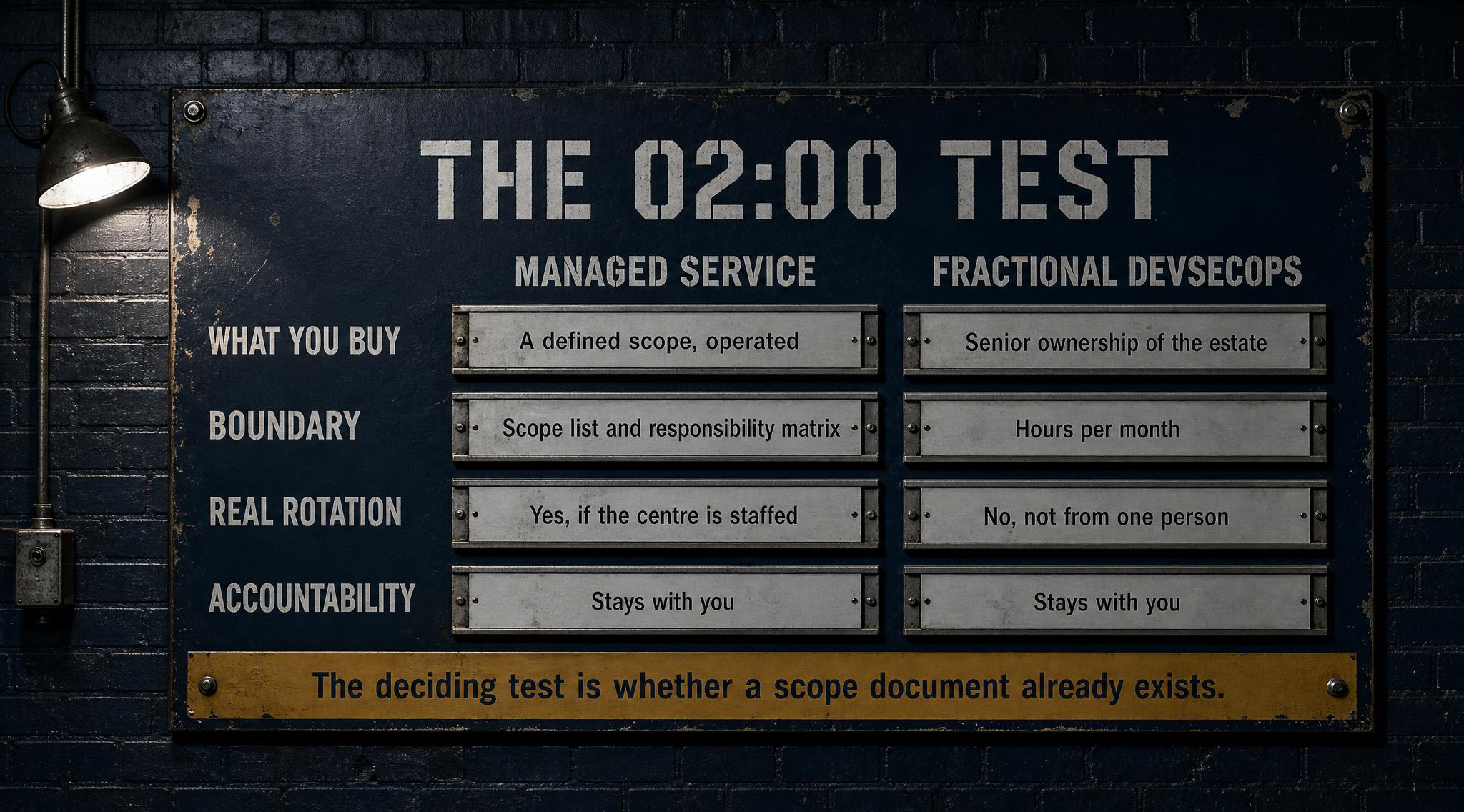
The question arrives in almost exactly these words: "is fractional devsecops worth it for a 10 person startup or should we just use a managed service". It is usually the second question a founder asks, right after pricing a DevOps hire and quietly putting the job description back in the drawer. Both options cost less than the hire. That is the only thing they have in common.
Most comparisons are written by one side or the other, so they line up price against responsiveness and stop there. That misses what actually decides it. These are not two vendors selling the same service at two price points. They are two different purchases. A managed service sells you a defined scope operated to a contract. A fractional team sells you ownership of an estate that does not have a defined scope yet. You can buy the wrong one at a fair price and still be exposed.
This post draws the boundary at the one moment that exposes it: 02:00, when something is broken and somebody has to act. Who picks up, what they are contractually allowed to touch, and what lands back on your side either way. Then it says plainly when the managed service is the better buy, because for a real set of ten person startups it is. Where I am giving a practitioner read rather than citing a document, it is labelled inline.
Quick context: two purchases wearing one label in 2026
The managed service category is old and well defined. The joint advisory AA22-131A, issued on 11 May 2022 by the cyber security agencies of the United States, United Kingdom, Australia, Canada and New Zealand, defines managed service providers as entities that deliver, operate or manage ICT services and functions for their customers through a contractual arrangement such as a service level agreement. Read that definition closely. The contract is part of the product. The scope is the thing you are buying.
Fractional engineering has no equivalent definition and no standard contract. It is senior time bought by the month, with the scope set by whatever your estate needs this quarter. That looseness is the feature and the risk at the same time. It is also why the two cannot be compared on an hourly rate: one is a service boundary, the other is a seat at your table.
is fractional devsecops worth it for a 10 person startup or should we just use a managed service?
Buy the managed service when the work is operating a stable, standard estate to a response time you can hold someone to. Buy fractional when the work is deciding what the estate should be, and nobody has yet written down what "managed" would even cover. At ten engineers most teams are in the second case, so fractional is usually the better first purchase. The deciding test is not price. It is whether a scope document already exists.
That is the whole answer. Everything below is the evidence, and the last two sections are the cases where the managed service wins outright.
1. What a managed service contracts to own
A managed service owns a named list of activities, and the list is the product. The clearest public example is AWS Managed Services, which publishes a responsibility matrix assigning each activity in an application lifecycle to either the customer or AMS, marked R for the party doing the work, C for consulted and I for informed. Some rows carry R on both sides, where the documentation describes joint ownership for responding to infrastructure and application issues.
Two details in that same matrix are worth more than any sales call. AMS expects a response from the customer within 24 business hours on decisions it needs, and may choose an action on your behalf if no reply arrives. And AMS is explicitly not responsible for activities in Customer Managed accounts, so the matrix simply does not apply there. AWS also lists an end of support date for AMS Advanced of 30 June 2027.
Takeaway: ask for the provider's responsibility matrix before the price. If they do not have one, you are buying a promise, not a service.
2. What a fractional team contracts to own
A fractional arrangement inverts the structure. Instead of a scope list, you get a quantity of senior time and a named person who treats the whole estate as theirs. MatrixGard publishes its own retainers on this basis: Starter at $2,500 per month, or ₹30,000, for up to 20 hours a month plus async access, aimed at teams of 5 to 15 engineers. Growth is $5,000 or ₹1,00,000 for up to 40 hours. Scale is $10,000 or ₹2,50,000 for up to 80 hours.
Notice what is missing from those tiers: a list of covered systems. That is deliberate, and it is the actual difference. The retainer covers infrastructure as code, the delivery pipeline, identity, exposure and cloud cost across whatever you are running, including the parts a managed scope would have excluded. The cost of that breadth is that hours are finite and there is no service level on everything.
Takeaway: a fractional retainer is bounded by hours, a managed service by scope. Decide which boundary you can live with.
3. The 02:00 test: who picks up, and what they may touch
At 02:00 three things decide the outcome: whether anyone answers, how fast, and whether they are permitted to fix the thing that is actually broken. The third one is where most engagements fail, and it is a scope question rather than an effort question.
Contractual response times are published and worth knowing as a baseline. AWS's own support plan announcement lists a target response of 15 minutes for Enterprise Support on business critical cases, 30 minutes for Business Support+, and 5 minutes for the Unified Operations plan. MatrixGard's published policy is different in kind rather than in speed: production down is covered at any hour on every plan, and everything else is next business day.
Those are two different shapes of commitment. One is a clock, the other is a category. Practitioner opinion: a clock is only worth what the permissions behind it allow. A 15 minute response from a party whose matrix excludes your CI/CD pipeline does not help when the pipeline is what broke.
Takeaway: write down your last three incidents and check which model would have been allowed to resolve each one.
4. The rotation arithmetic neither model escapes
Continuous cover is a staffing problem, and the numbers are public. Google's Site Reliability Engineering book sets the minimum for a single site on-call rotation at eight engineers, assuming two people on call at any time as primary and secondary, with week long shifts giving each engineer a turn about once a month. For a dual site follow the sun rotation the minimum is six per team. The arithmetic comes from capping on-call at 25 percent of the relevant time.
Apply that honestly to both options. A one person fractional arrangement is not a rotation, and no retainer wording turns it into one. A managed service with a genuinely staffed operations centre is a rotation, and that is a real structural advantage you cannot buy from an individual at any price. A managed service that is three people and a shared phone is not one either, whatever the contract says.
Takeaway: ask how many named engineers sit in the rotation. Eight is the number the published research points at, and anything under it is a best effort arrangement wearing a service level.
5. The work that falls outside every managed scope
At ten engineers a surprising share of the infrastructure work is not operations at all. It is decisions: how accounts are structured, what the pipeline is allowed to deploy without a human, which identity model you commit to before the second product line arrives. None of that is a ticket, so none of it belongs to a party paid to close tickets.
This is the same boundary problem that shows up when a team tries to compress three job families into one person, covered in can one person really handle cloud, DevOps and security. The pattern repeats: the operable work compresses cleanly, the decisions do not delegate to a scope. A managed service is built to absorb the first category and is structurally wrong for the second.
Takeaway: split your backlog into tickets and decisions. If the decisions column is longer, a managed service will not reduce it.
6. Compliance evidence: the carve-out that lands back on you
Buyers assume a provider's SOC 2 report covers them. Under the carve-out method it does not, and the mechanism is worth knowing by name. A service organisation's report lists complementary user entity controls, which are the controls the report assumes you operate at your end, and complementary subservice organisation controls, which are disclosed as expected of a carved out vendor rather than tested by the auditor.
The report arrives, and the controls it assumed you were running are still yours to evidence. Neither model removes that. The difference is who assembles the evidence: a managed service hands you artefacts for its own scope, while a fractional engagement can own the whole evidence set, including the security questionnaire answers and the type 1 or type 2 decision set out in SOC 2 type 1 versus type 2.
Takeaway: request the provider's complementary user entity controls list during evaluation. It is the precise list of work that stays with you.
7. Regulated estates: the activity moves, the accountability does not
If you are regulated, the choice narrows for reasons that have nothing to do with engineering preference. The Reserve Bank of India's Master Direction on Outsourcing of Information Technology Services, issued on 10 April 2023 and applicable from 1 October 2023, governs material IT outsourcing by banks, urban co-operative banks, NBFCs and credit information companies, where material means a disruption would significantly affect business operations.
The structural point, examined in detail in the RBI outsourcing direction walkthrough, is that you can outsource the activity and not the accountability. The entity stays responsible for customer data confidentiality and integrity while a provider processes it, and reliance on third party certifications does not absolve it of its own responsibility. A board approved policy and vendor oversight are required artefacts either way.
Takeaway: in a regulated estate the question is not which model is accountable. You are. The question is which one produces the oversight artefacts your regulator expects.
8. The provider is also an attack path, in both models
Any party with standing privileged access to your estate is part of your attack surface. AA22-131A was published precisely because the agencies expected attackers to target the trust relationship between providers and customers, and noted that the access a provider holds means one successful compromise can cascade across its customer base. The advisory asks customers to verify that their contractual arrangements include cyber security measures matching their own requirements.
Two national agencies publish evaluation material you can use directly rather than inventing your own questionnaire. The UK NCSC guide to choosing a managed service provider points out that providers hold access to your systems and data, which can include your customers' details, and suggests checking Cyber Essentials certification. Australia's ACSC publishes a question set covering whether the provider implements better practice security against the Essential Eight and whether it administers your systems securely.
Takeaway: run the same access review on a fractional engineer and a managed provider. Standing privilege is the risk, and neither model is exempt.
9. What each one costs a ten person startup
Published numbers only, because the honest comparison does not need invented ones. On the fractional side the figures above are the list prices: $2,500 or ₹30,000 a month at Starter for up to 20 hours, with incident work billed hourly at $500 or ₹7,500 for production down and $350 or ₹5,000 for urgent but not down.
On the managed side, pricing varies so widely by provider that any single figure would be fiction. What is published is the cloud vendor's own floor: AWS Enterprise Support carries a minimum of $5,000 a month, reduced from $15,000, with the fee charged as the greater of that minimum or a tiered percentage of AWS spend. Unified Operations carries a $50,000 monthly minimum, Business Support+ starts at $29 per account, and Developer Support, the previous Business Support and Enterprise On-Ramp are discontinued from 1 January 2027.
That AWS floor is a calibration, not a competitor quote: it is the price of a response time on AWS services alone, with your pipeline, your IaC and your compliance evidence all outside it. The broader retainer market context sits in DevOps and DevSecOps retainer costs in India.
Takeaway: compare total cost of the outcome, not the monthly line. Add what each model leaves on your plate.
10. When the managed service is the better buy
Four cases, stated plainly. First, when you need a staffed rotation with a contractual clock and you have fewer than eight engineers who could ever carry on-call. A managed operations centre is structurally better at this than any individual. Second, when your estate is standard and stable, so the work genuinely is operations and a scope document can be written without guessing.
Third, when a customer or regulator requires a named provider with its own attested controls and a service level you can produce in a procurement review. Fourth, when the volume is high and commoditised, such as patching a large fleet, where per unit price beats judgement. Practitioner opinion: if two or more of those four describe you, buy the managed service and do not let anyone talk you out of it.
The strongest arrangement at this stage is often both, in sequence: fractional ownership to decide the architecture and write the scope, then a managed service to operate what was decided. Handing that scope over cleanly is its own task, set out in what happens when a fractional contract ends.
Summary: what each model owns
| Dimension | Managed service | Fractional DevSecOps |
|---|
| What you buy | A defined scope, operated | Senior ownership of the estate |
| Boundary | Scope list and responsibility matrix | Hours per month |
| 02:00 cover | Contractual clock inside scope | Category based, production down |
| Real rotation | Yes, if the centre is staffed | No, not from one person |
| Architecture decisions | Outside scope | The core of the engagement |
| Compliance evidence | Its own scope only | Can cover the whole set |
| Accountability | Stays with you | Stays with you |
| Best fit | Stable, standard, high volume | Changing estate, no scope yet |
Stage recommendation
Pre-seed, under 10 engineers. Fractional, almost always. There is no scope to manage yet and the decisions you make now set the cost and risk curve for two years. A managed service at this stage prices the operation of an estate you have not designed.
Seed, 10 to 20 engineers. Fractional for ownership, plus the cloud vendor's own support tier for platform response. This is the configuration where the two models stop competing. Revisit when a scope document exists and is stable for two quarters.
Series A, 20 engineers and up. Split it. Managed service for the operable, repeatable layer, fractional or in house for architecture, security and compliance. If you are contracting an EU or UK customer, the supplier security clauses will shape the split for you.
Where to start
Before you price either option, run the test that makes the answer obvious: list your last three incidents and your next three infrastructure decisions. If the incidents sit inside one tidy scope and the decisions column is short, a managed service is the cheaper correct answer. If the decisions column is long, no scope document will cover it.
If you want help drawing that line on your own estate, the free infrastructure checklist walks the same ground: what is running, who can change it, what breaks at 02:00 and who is allowed to fix it.
About the author
Avinash S is the founder of MatrixGard, a fractional DevSecOps practice for early stage startups, funded or bootstrapped. He works on cloud architecture, delivery pipelines, identity and cloud cost for teams that do not have a dedicated infrastructure person yet.
Methodology and sources
This post answers the question "is fractional devsecops worth it for a 10 person startup or should we just use a managed service" using public documents and MatrixGard's own published price list. No client engagement, outcome or testimonial is described anywhere in it, and no figure appears that is not either published by its owner or labelled as a practitioner read.
Primary sources: the CISA joint advisory AA22-131A and its NCSC-hosted text for the managed service provider definition and the trust relationship risk; the AWS Managed Services responsibility matrix for how a managed scope is documented; the AWS shared responsibility model for the underlying split; AWS Support getting started and the AWS support plan announcement for response targets, minimums and the 2027 plan changes; chapter 11 of Google's Site Reliability Engineering book for the on-call rotation minimums; the RBI Master Direction on Outsourcing of IT Services for the regulated case; NIST SP 800-53 Revision 5 control AC-5 for separation of duties; the NCSC guide to choosing a managed service provider and the ACSC questions to ask managed service providers for provider evaluation; and this explainer on carve-out versus inclusive subservice treatment for the complementary controls mechanism, with the AICPA attestation standards as the authoritative reference behind it.
Prices quoted for MatrixGard are its published list prices and are subject to change. Where a provider's pricing is not published, this post says so rather than estimating it.