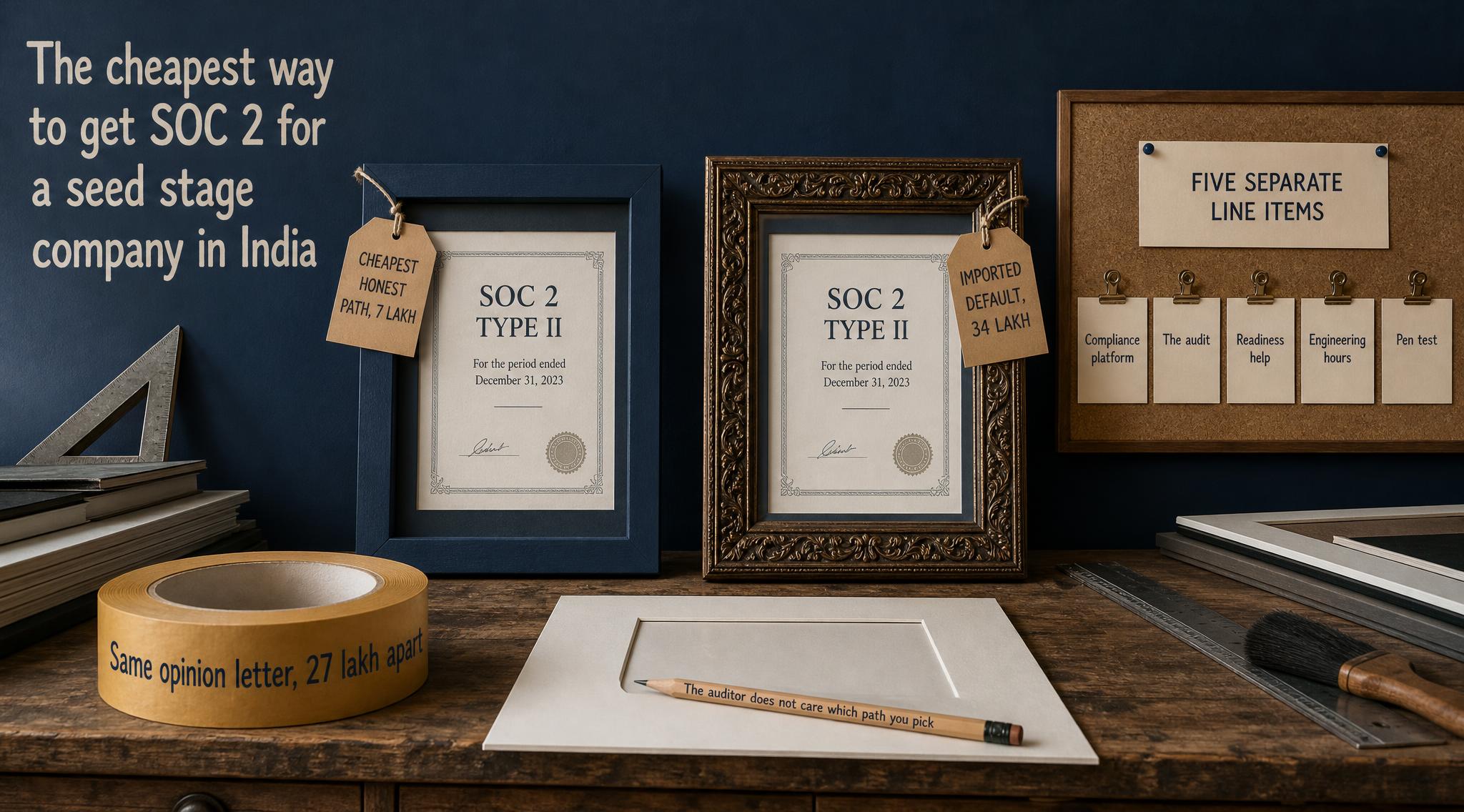
The cheapest way to get SOC 2 for a seed stage company in India runs roughly ₹7 lakh to ₹11 lakh for a first Type 2 cycle, bought as five separate line items. The same report, bought as one imported bundle, models out past ₹34 lakh. The opinion letter your customer reads is identical either way.
This post is for the founder whose investor or first enterprise customer just said the words "SOC 2" and who now has a budget question and a deadline. It is written for an Indian-incorporated SaaS company with a 5 to 30 person team, going through the first audit cycle, on the Security criterion.
Generic cost articles get two things wrong. They quote one line item, usually the compliance software, as if it were the project. And they are mostly written by the vendors selling that line item, so the slice looks like the pie. What follows is the whole invoice, with the published prices named and the unpublished ones labelled as estimates.
The cheapest way to get SOC 2 for a seed stage company, in one paragraph
The cheapest way to get SOC 2 for a seed stage company is a Type 2 report on a short observation window, assembled from five India-market line items instead of one bundled Western package. For a first cycle that lands around ₹7 lakh to ₹11 lakh all in. The five items are a compliance platform, the audit itself, readiness help, your own engineering hours, and a pen test. Only the readiness help is genuinely optional, and it is the item founders cut last instead of first.
"an investor asked about soc 2, what is the cheapest way for a seed-stage company to get started?"
Ask the investor which customer or which deal the report is actually for, then scope to that answer and nothing wider. If no named deal is waiting, the cheapest first step costs no money at all: a readiness pass against the Security criterion, using the free tier of a compliance platform, to find out how far off you are. If a deal is waiting, book the auditor before you buy any software. The auditor sets the observation window, and the window sets every other number on this page.
That ordering is the single largest saving available at seed stage, and almost nobody does it. Software gets bought first because it is the easiest thing to buy.
Type 1 or Type 2: the comparison that decides your bill
A Type 1 report tests whether your controls are designed properly on one specific date. A Type 2 tests whether those same controls actually operated over a period of time. Both are issued under AICPA attestation standards by a licensed CPA firm, and both use the same Trust Services Criteria, so the difference is the testing window, not the rigour of the framework (Drata, AICPA).
The standard does not fix a minimum window. Three months is the market convention for a first Type 2, six months is the common choice, and twelve is what buyers in regulated sectors ask for (Wolfia, QuickStart). Shorter windows cost less because there is less evidence to sample.
| Question | Type 1 | Type 2 |
|---|
| What it tests | Control design on a single date | Design plus operating effectiveness over a window |
| Window | A point in time | 3 to 12 months, no fixed minimum in the standard |
| Relative price | The cheaper single report | Prices around 1.3x to 1.5x a Type 1 for the same controls |
| What enterprise buyers ask for | Sometimes accepted as an interim | The one usually named in procurement |
| Can become a public SOC 3 | No | Yes, a SOC 3 is derived only from a Type 2 |
The decision rule. If your deadline is under 60 days, buy a Type 1, because it is the only thing that can exist in time. In every other case go straight to a three month Type 2, because a Type 1 bought first is a document most enterprise buyers will ask you to replace, and you pay the audit fee twice to learn that. The Type 2 multiple above is sourced from Sprinto and Comp AI, and the SOC 3 point from Withum. The longer version of this comparison is in SOC 2 Type 1 vs Type 2 for SaaS startups.
Line item one: the compliance platform, and who actually publishes a price
This is the software that collects evidence from your cloud accounts so a human does not have to screenshot it. You will need one. The useful fact for a budget is that almost nobody in this category publishes a rate card.
Vanta, Drata, Sprinto and Scrut all gate startup pricing behind a demo call, which is why every figure you find for them online is a third party estimate rather than a quoted price. Treat those numbers as directional and get your own quote. The exception is Comp AI, which is open source and publishes its tiers: a self hosted Starter plan at zero, and a managed "Done For You" plan listed at $997 per month for companies up to 25 people, including a third party audit on a twelve month minimum term, as listed in October 2026.
Indian market reporting puts Sprinto and Scrut at roughly ₹2 lakh to ₹5 lakh a year at a single framework startup tier, against ₹5 lakh to ₹15 lakh for the US platforms quoted in dollars (GRCDesk, Mitigata). Practitioner opinion: for a single product seed stage SaaS on the Security criterion, the capability gap between these platforms is small enough that the choice should come down to INR billing and the quality of integrations with your actual stack.
Takeaway: price the one vendor that publishes, then use it as the floor you negotiate the others against.
Line item two: the audit, where the firm name costs more than the opinion
The auditor is a licensed CPA firm that inspects your evidence independently and issues the opinion letter. This line is the one most founders do not know exists until month four, because no software pricing page includes it.
Published and reported Indian market bands for a first year Type 2: India resident SOC 2 boutiques from about ₹3 lakh to ₹4.2 lakh for a starter package, often bundled with a pen test (soc2.in); Indian compliance first firms at ₹4 lakh to ₹6 lakh for a 10 to 30 person company (Parafox, Z Cybersecurity); and Big Four India practices at a different order of magnitude when they quote a company this size at all (Neumetric).
The opinion letter carries the same weight whichever licensed firm signs it. What varies is whether your customer has a named firm requirement in their procurement policy, and that is a question you can answer in one email before you spend anything.
Takeaway: send that email first. A specific firm requirement is rare, and it changes this line item by lakhs.
Line item three: readiness help, from zero to a retainer
Readiness is the work of closing the gap between how you run today and what the criteria expect: access reviews, change management, logging, vendor records, policies people actually follow. The platform templates can carry a team that has someone able to absorb the work. They cannot carry a team that does not.
Three honest price points. Doing it yourself costs nothing in cash. A fractional or virtual CISO retainer for a few months is the middle path, and MatrixGard publishes its own entry tier at ₹30,000 per month ($2,500) on the pricing page, which is the number quoted here rather than a range invented for this post. A large advisory firm is the expensive end and is almost always overkill at seed stage.
The test for which one you need is specific, not a matter of confidence: ask whichever engineer will own this whether they have read the Trust Services Criteria. If the answer is no, the hours in the next section will quietly cost you more than the retainer would have. The market options are compared in virtual CISO services for Indian startups.
Takeaway: this is the only one of the five you can take to zero, so decide it deliberately rather than by default.
Line item four: engineering hours, the cost no pricing page lists
SOC 2 Type 2 needs evidence that controls ran: log retention settings, change management trails, periodic access reviews, scan output, vendor documentation, training records. A platform pulls a large share of that automatically. It does not pull all of it, and the remainder is engineering time.
Budget 80 to 200 engineering hours across the observation window for a first cycle. At a fully loaded ₹3,000 to ₹5,000 an hour for a senior engineer, that is ₹2.4 lakh to ₹10 lakh of capacity moved off product. It is real money even though no invoice arrives for it, and it is the most common reason a compliance budget doubles mid cycle.
The lever here is integration coverage, not discipline. Pick the platform that already reads your cloud, your identity provider and your CI system, and the manual residue shrinks. A tidy IAM surface before you start also removes a large slice of the evidence work, which is the argument in the IAM audit walkthrough.
Takeaway: put these hours in the budget as a number. A hidden cost is still a cost, and this one decides whether the project lands on schedule.
Line item five: the pen test your auditor will require
Your auditor will want a penetration test result for the application in scope. This one is not optional, but the delivery is a real choice with a wide price band.
Astra publishes yearly pricing, which makes it the easiest anchor to quote: its pentest plan is listed at $5,999 per year, with India tiers listed at ₹1,67,000 for Scanner and ₹5,00,000 for Pentest (Astra pricing, Astra VAPT guide). The same guide puts the broader Indian market at ₹40,000 to ₹8,50,000 for a single application, which is the range you should expect quotes to fall inside. Other Indian reporting lands a thorough manual and automated test for a SaaS application around ₹1.5 lakh to ₹3 lakh (Neumetric VAPT, BM Infotrade).
A continuous pentest subscription is a reasonable security purchase and a poor way to buy one audit artefact. For a single first cycle, a scoped one off test from a CERT-In empanelled firm is the defensible floor.
Takeaway: buy the test the auditor needs this cycle, not a programme you will not use until next year.
Bridge letters, the line item that appears after you sign
Customers whose procurement runs on a different calendar than your audit will ask for a bridge letter: a short statement from your auditor covering the gap between the end of your observation window and today. Each one is a separate piece of work, and each one is priced as such.
Indian market reporting puts them in the region of ₹50,000 to ₹1.5 lakh per letter. The saving is structural rather than clever: negotiate one or two into the original audit scope at signing, because afterwards each becomes its own engagement at full rate. Teams that skip this discover it during a security questionnaire, which is the scenario covered in the security questionnaire guide.
Takeaway: ask for two bridge letters in the audit contract. It costs nothing to ask before you sign and a lakh to ask after.
The five line items priced end to end
Three paths, built by adding up the bands above rather than by quoting anyone. These are modelled totals, not quotes anybody received.
| Line item | Cheapest honest path | Typical Indian seed stage | Imported default |
|---|
| Compliance platform | ₹2.5 lakh | ₹3 lakh | ₹8 lakh |
| The audit | ₹3 lakh | ₹4 lakh to ₹5 lakh | ₹15 lakh |
| Readiness help | ₹0, founder led | ₹1 lakh | ₹6 lakh |
| Pen test | ₹1.5 lakh | ₹2 lakh | ₹5 lakh |
| Engineering hours | In the 80 to 200 hour band above | Same band | Same band |
| Cash total | 7 lakh | ₹10 lakh to ₹11 lakh | 34 lakh |
The right hand column is what happens when a company imports the stack its investors recognise: a US platform, a Big Four audit, a Western pen test firm and an advisory retainer. Add the upper ends and the arithmetic gives 34 lakh. Against the cheapest defensible Indian path at 7 lakh, that is Same opinion letter, 27 lakh apart. The auditor does not care which path you pick, and neither does the customer reading the report.
The first 30 days after the investor asks
Order of operations, because sequence is where the money leaks.
- Days 1 to 3. Find out which deal or diligence item the report is for, and whether anyone has a named audit firm requirement. One email each.
- Days 4 to 10. Talk to two or three auditors before any software vendor. Ask what observation window they will accept, what their fee covers, and whether bridge letters can sit inside the scope.
- Days 11 to 20. Run a free readiness pass. Write down the gaps. This is the list that tells you whether you need the readiness retainer at all.
- Days 21 to 30. Buy the platform, with the auditor already chosen and the window already agreed. Book the pen test for late in the window, not at the start.
Takeaway: the auditor is the first purchase conversation and the last one most teams have. Reversing that order is free and changes the total.
What to do at pre-seed, seed and Series A
Pre-seed. Do not buy a SOC 2. Nothing about an attestation gets cheaper by being early, and a report with no deal behind it expires unused. Run the free readiness pass, fix what it finds, and write a one page security summary you can send when asked. If an investor asks, "no SOC 2 yet, here is our control posture and our trigger for starting" is a complete answer.
Seed. This is where the cheapest honest path belongs, and where this whole post is aimed. One named enterprise deal is enough to justify it. Go straight to a three month Type 2 on the Security criterion, founder led readiness, Indian suppliers for the audit and the test.
Series A. The calculation changes because the report is now recurring and multiple frameworks are usually in view. At that point the question stops being the cheapest single report and becomes who owns the control environment every year, which is the retainer question priced in the DevSecOps retainer cost breakdown. If DPDP Act obligations are also in scope, the overlap is worth mapping once rather than twice.
What this post does not cover
Criteria selection beyond Security, which is a decision with real cost consequences and deserves its own treatment. Specific control implementation, meaning the actual configuration work in your cloud. And the ISO 27001 comparison, where Indian certification bodies compete on price against UK and US bodies and surveillance audits recur annually (Wattlecorp). The AICPA criteria text itself is free to read and worth the afternoon.
One more thing this post does not contain, deliberately: a case study. MatrixGard has no SOC 2 client outcome to show you, so every number above is either a published price or sourced reporting, labelled as which. A cost guide that quotes anonymous clients at you is quoting nothing.
Start with the gap list, not the purchase
The cheapest version of this project starts with knowing exactly which controls you are missing, because that list is what decides whether you need the readiness line item at all. The free cloud security checklist on the MatrixGard site walks the same ground an auditor will: identity, logging, change management, backups and vendor records. Work through it, write down what fails, and you will have the one document that makes every auditor conversation shorter and every quote smaller.
If you want a second read on your specific path, the fastest route is to send the stack you run and the deadline you are working to.
About the author
Avinash S is the founder of MatrixGard, which provides fractional cloud, DevOps and security work for startups that cannot yet justify the full time team they need. Close to a decade building, breaking and securing cloud infrastructure for startups, funded and bootstrapped.
Methodology and sources
Updated 10 October 2026. Prices in this post are of two kinds, and the difference is marked in the text. Published prices are quoted from the vendor's own page and dated: Comp AI tiers from trycomp.ai/pricing, Astra from its pricing page and VAPT guide, and the MatrixGard entry tier from matrixgard.com/pricing. Reported bands come from Indian market secondary sources that are named inline where used: GRCDesk, Neumetric, Parafox, soc2.in, Cybersecify, Z Cybersecurity and Mitigata.
Vendors that gate pricing behind a sales call are described as gated rather than assigned a number, because a third party estimate presented as a price is how a budget goes wrong. Observation window conventions are market practice from Wolfia and QuickStart, not a requirement of the standard; the AICPA sets no fixed minimum. Report type definitions are from Drata and AICPA. The three totals in the summary table are modelled by adding the bands in this post and are explicitly not quotes anyone received. Every figure is directional: get a real quote before you budget.