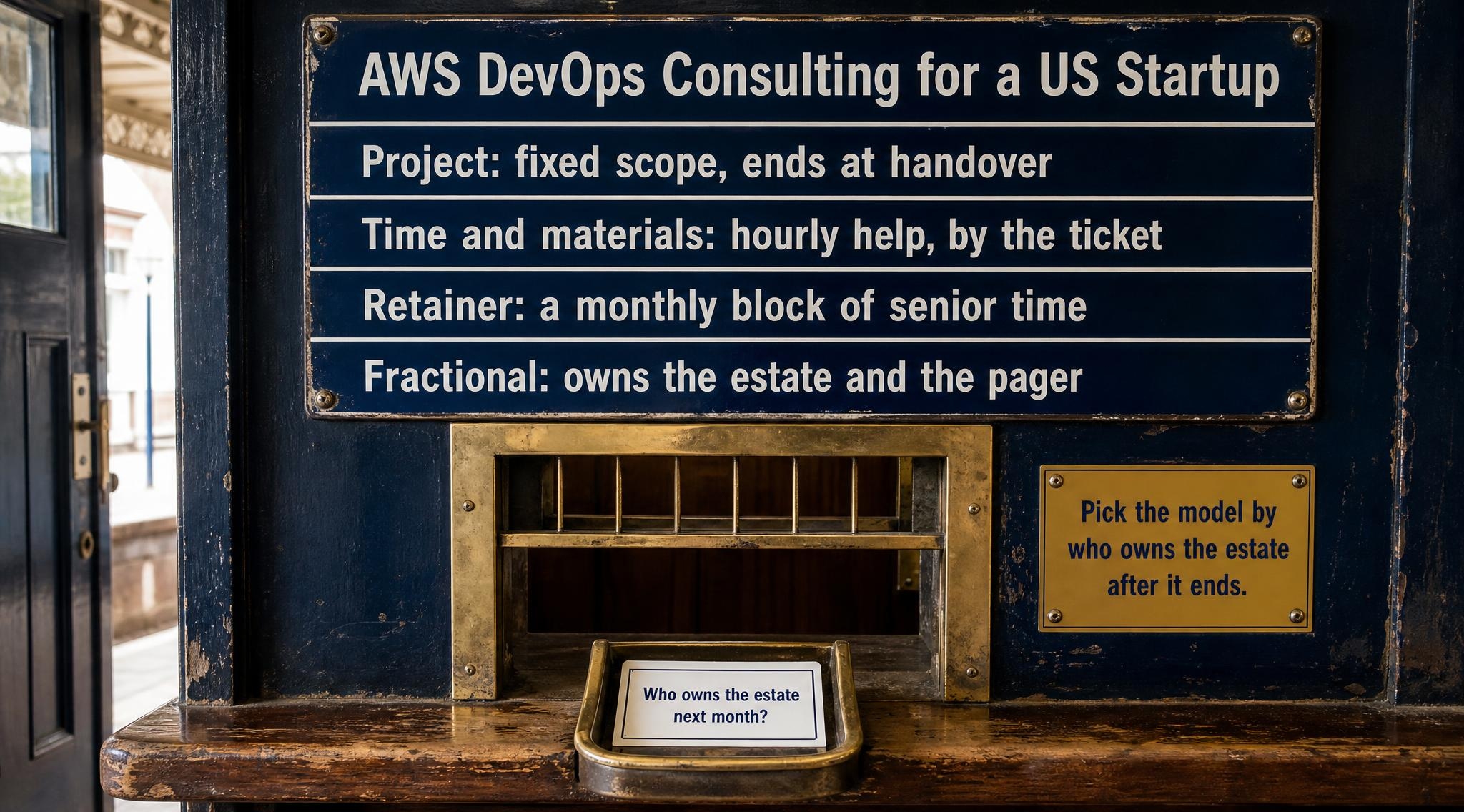
If you are a US seed startup with no DevOps hire and you have started searching for aws devops consulting, you are about to buy one of three different things that share one label: a project, a retainer, or a fractional team. They are priced differently, they end differently, and they leave you holding different things when they end. This post compares them on scope, price and what happens if you do nothing, and gives a decision rule for seed stage.
I am Avinash S, and I run MatrixGard, a fractional DevSecOps practice. That makes me one of the three options, so the bias is stated up front. The point of this post is the opposite of a pitch: for a real share of seed startups the right answer is a fixed project, and this post says when. Where I am giving a practitioner read rather than citing a document, it is labelled inline. If you want a list of named providers rather than a comparison of models, that lives in the US fractional DevSecOps provider list.
What most articles on this get wrong is the unit of comparison. They compare hourly rates. The rate is the least informative number in the deal. The questions that decide it are: what is in scope, who is on the hook at 02:00, and what is in your repository on the day the engagement stops.
Quick context: how AWS DevOps help is bought in 2026
The buying channels shifted this year. AWS IQ, the AWS-run marketplace where customers posted a job and certified freelancers bid on it, stopped taking new expert registrations on 20 May 2025 and was discontinued on 28 May 2026, according to the AWS IQ documentation. The nearest AWS-native replacement is Professional Services in AWS Marketplace, where consulting partners list assessments, implementation, managed services and training, usually sold as a negotiated private offer that lands on your AWS bill. In June 2026 AWS cut the listing fee for professional services private offers to 0.5%, down from 2.5%, and the same announcement mentions time-and-materials billing.
Outside AWS, the channels are what they have always been: consulting firms with an AWS Partner badge, independent freelancers on general marketplaces, and small fractional practices that sell a monthly retainer. The engagement models below cut across all of those channels. A Premier partner can sell you a project; a freelancer can sell you a retainer. Pick the model first, then the channel.
AWS DevOps consulting: what it is
AWS DevOps consulting is paid outside help to design, build or run the delivery and operations layer of a product hosted on AWS: account structure, infrastructure as code, CI/CD pipelines, identity and access, monitoring, backups and cost controls. It is sold in three shapes. A project buys a defined outcome and ends. A retainer buys a monthly block of senior time. A fractional team buys ongoing ownership of the estate, including being the one who answers when it breaks.
1. What an engagement actually covers
Every credible engagement maps onto the same checklist, and it is public. The AWS Well-Architected Framework has six pillars: operational excellence, security, reliability, performance efficiency, cost optimization and sustainability. The Well-Architected Tool that walks you through those questions carries no additional charge; you pay only for the underlying AWS resources.
In practice, a seed-stage scope usually covers some subset of these:
- Account structure: a multi-account layout through AWS Organizations, so production is not the same account the interns test in.
- Infrastructure as code: Terraform, OpenTofu or CloudFormation in your repository, so the estate can be rebuilt without the person who clicked it together.
- CI/CD: a pipeline that builds, tests and deploys on merge, with a rollback path.
- Identity: SSO for humans, short-lived roles for machines, no long-lived access keys on laptops.
- Observability: logs, metrics and an alert that reaches a person.
- Backups and recovery: tested restores, not just enabled snapshots.
- Cost controls: budgets, anomaly alerts and tagging.
The AWS shared responsibility model is the reason all of this is yours to buy: AWS secures the cloud, and everything you configure in it is on your side of the line. Takeaway: ask any provider to map their proposal onto the six pillars. Anything they cannot map is either padding or a gap.
2. The project model: a defined outcome, then it ends
A project buys a named deliverable against a statement of work: "move us from one account to an Organizations layout with Terraform and a CI pipeline", for example. Price is fixed or capped, the deliverable is checkable, and the engagement ends on acceptance.
For reference, MatrixGard's own published price list puts a Quick Fix at $5,000 to $7,500 and a Sprint at $12,000 to $18,000. Other firms price projects differently and most do not publish, so treat these as one published data point, not a market rate.
What a project does not buy is the month after. The pipeline will need a change when you add a service. The alert will fire on a Saturday. Practitioner opinion: the most common failure of a well-delivered project is that it works perfectly and then drifts for six months, because nobody inside the company understood it well enough to change it. That is not the consultant's fault; it is what the model is.
Takeaway: a project fits when the outcome is finite and you have someone in-house, even a backend engineer, who will own it afterwards. Write the handover into the statement of work, not as a goodwill extra.
3. Time and materials: hourly help, by the ticket
Time and materials is the freelancer default: you pay for hours used, usually through a marketplace. It is flexible and it is the cheapest way to get one specific question answered by someone who has seen it before. Published rates vary widely. A 2026 freelance rate guide from goLance puts freelance DevOps engineers at roughly $40 to $325 per hour, with mid-level engineers averaging around $100. That is a marketplace's own survey, so read it as direction, not as a benchmark.
The weakness is structural. Nobody on an hourly contract is accountable for the estate between tickets. You are the project manager, the architect and the person who decides what to fix next, and your time is the expensive input you did not count.
Takeaway: time and materials fits a team with a strong technical founder who knows exactly what they want and only needs hands, or as a way to trial someone for two weeks before committing to anything larger.
4. The retainer model: a monthly block of senior time
A retainer buys a reserved block of a senior person's time each month, usually with a response commitment. You get continuity: the same person learns your estate and the second month costs less thinking than the first. The provider is still, in most retainers, responding to requests. You ask, they do.
MatrixGard publishes its retainers at $2,500 per month for Starter, $5,000 for Growth and $10,000 for Scale for companies outside India, listed on matrixgard.com/pricing. India pricing is listed separately, and the reasoning for that split is in the India retainer cost post. Many firms do not publish retainer prices at all; ask for the monthly number and what it includes in writing before the first call ends.
What to check in any retainer: what happens to unused hours, what the response time is out of hours, whether the provider can make changes in production or only advise, and what the notice period is. A retainer with a 90-day notice period and no exit artefacts is a lock-in, whatever it is called.
Takeaway: a retainer fits when the work is continuous but you still want to direct it, and you have someone who will set the priorities each week.
5. The fractional model: owns the estate and the pager
Fractional is a retainer with one difference that changes everything: the provider owns outcomes, not tickets. The fractional team decides what gets fixed this month, keeps the roadmap, holds the on-call, and is the named owner of the infrastructure in your org chart. You stop being the project manager for work you do not understand.
The on-call part matters more than it looks. Google's Site Reliability Engineering book, chapter 11, sets the minimum for a single-site on-call rotation at eight engineers. No seed startup has eight infrastructure engineers, so a one-person hire cannot hold a sustainable rotation either. Practitioner opinion: the honest version of fractional is not "we are awake at all hours", it is "the pager reaches someone who already knows the system, and the system is built so it rarely fires". Ask any fractional provider which of those they are selling. The longer version of the one-person question is in one person or three hires.
The risk in fractional is concentration: one outside party knows your estate. The mitigation is contractual and checkable, and it is covered in section 9.
Takeaway: fractional fits when nobody in the company wants to own infrastructure, the estate is changing every month, and you would rather buy a decision-maker than a pair of hands.
6. The baseline you are comparing against: a full-time hire
Every model above is implicitly priced against hiring. The US Bureau of Labor Statistics does not publish a separate DevOps occupation, but its Occupational Outlook Handbook entry for software developers reports a median annual wage of $133,080 for May 2024. That is a median for all software developers nationally, before benefits, payroll tax, equity and recruiting cost, and a senior engineer who can run AWS production alone in a major hiring market will usually cost more than the median.
The salary is not the only cost. A single hire is a single point of failure, holds no rotation, and takes months to recruit. A hire is also a better owner than any consultant in one specific way: they are in the room when the product decisions get made, and they are there in year three.
Practitioner opinion: for a seed company with fewer than about 15 engineers and one product, the hire usually arrives too early. After Series A, when infrastructure changes are daily and compliance work is continuous, the hire usually wins, and a good fractional provider should tell you when you have reached that point.
Takeaway: compare any proposal against the full cost of a hire, not the salary line, and against the date the hire would actually start.
7. What an AWS Partner badge does and does not verify
AWS Partner tiers are real signals of the firm, not of the person who will work your account. The AWS Services Path tiers are Select, Advanced and Premier, with requirements that scale in accredited individuals and customer revenue, plus an annual program fee. The AWS DevOps Competency validation checklist requires the partner to already be in the Advanced or Premier tier, to submit customer case studies with architecture diagrams, and to pass a technical validation.
That is meaningful due diligence on the company. It does not tell you who will be assigned to your account, how senior they are, or whether a seed-stage estate of a dozen services is a priority for a firm whose case studies are enterprise migrations.
Takeaway: when a badge is offered, ask for the name of the engineer who will do the work and a sample of their actual output, such as a redacted Terraform module or runbook. The checks worth running on any provider are in how to verify a consultant before signing.
8. What AWS gives you before you pay anyone
Before spending on consulting, use what AWS funds. AWS Activate offers credits to startups: the Founders tier for self-funded companies and the Portfolio tier for companies backed by an Activate Provider such as an accelerator or VC firm, which AWS currently lists at up to $200,000. Amounts and eligibility change, so check the live page before you plan around a number.
Separately, AWS runs a partner-led Well-Architected program. The AWS Well-Architected partner funding page describes funding tied to a review completed in the Well-Architected Tool and to remediating at least 45% of the high-risk issues found. Partners describe the resulting credits differently, so ask any partner offering a "free review" exactly what the credits are, who receives them, and what the remediation commitment is.
Takeaway: run the free Well-Architected Tool yourself for an afternoon before the first sales call. You will ask better questions and you will see which providers are reading from the same list.
9. What you must hold when any engagement ends
Whatever the model, write the exit into the contract. At the end of a project, retainer or fractional engagement you should hold, in your own accounts and repositories:
- All infrastructure as code, in a repository your company owns.
- Admin access to every AWS account and every tool, with the provider's access removable in one step.
- Runbooks for deploys, rollback, restores and the alerts that page.
- An architecture diagram that matches what is actually running.
- A baseline of the four DORA metrics: deployment frequency, lead time for changes, change failure rate and time to restore service, so the next owner can see whether things got better or worse.
If a provider resists any item on it, that is the answer to whether you should sign. The full artefact list, and what to put in the exit clause, is in what happens when a fractional DevOps contract ends.
Takeaway: ask for the exit artefacts in the first proposal, not the last month.
10. What happens if you do nothing
Doing nothing is a choice with a predictable shape. The infrastructure keeps working, because it was built by a capable engineer to ship the product. What it lacks is an owner. Practitioner opinion: in a seed company without one, the usual pattern is a single AWS account, long-lived keys on developer laptops, no tested restore, and a bill nobody can explain line by line. None of that stops the product. All of it surfaces at the worst time: the first enterprise security questionnaire, the first incident, or the first due-diligence call in a fundraise.
Takeaway: the cost of doing nothing is not zero; it is deferred, and it is usually paid by your best product engineer at short notice.
Project vs retainer vs fractional: summary table
| Model | What you buy | Published price point | Who owns the estate after | Best fit |
|---|
| Project | Project: fixed scope, ends at handover | MatrixGard Sprint $12,000 to $18,000 | Your in-house engineer | A finite outcome and an internal owner |
| Time and materials | Hours, by the ticket | $40 to $325 per hour (goLance survey) | You, as project manager | A technical founder who only needs hands |
| Retainer | Retainer: a monthly block of senior time | MatrixGard Starter $2,500 per month | You direct, provider executes | Continuous work you want to steer |
| Fractional | Fractional: owns the estate and the pager | MatrixGard retainers from $2,500 per month | The provider, until handover | Nobody in-house wants to own infrastructure |
| Full-time hire | One employee | BLS software developer median $133,080 (May 2024, salary only) | The hire | Post Series A, daily infrastructure change |
Which one fits seed stage: the decision rule
Ask one question first: who owns the estate next month? If the answer is a named person inside the company, buy a project and hand it to them. If the answer is "nobody, and that is the problem", buy fractional. If you want to keep steering but need senior hands every week, buy a retainer. Pick the model by who owns the estate after it ends.
- Pre-seed: run the Well-Architected Tool yourself, claim Activate credits, and buy a small fixed project for account structure and identity if you have no one who has done it before.
- Seed: the realistic choice is between a project with an internal owner and a fractional team. If your engineers are all building product and nobody wants the pager, fractional is the better fit. If one engineer genuinely wants the infrastructure, give them a project and a short advisory retainer.
- Series A: start the hire. Use a fractional team to bridge the months of recruiting and to hand over cleanly to the person you hire.
If you want a quick read on where your AWS account stands before you talk to anyone, including us, open the free cloud security checklist.
About the author
Avinash S is the founder of MatrixGard, a fractional DevSecOps practice for early stage startups, funded or bootstrapped. He works on cloud architecture, delivery pipelines, identity and cloud cost for teams that do not have a dedicated infrastructure person yet.
Methodology and sources
This post answers the search "aws devops consulting" for a US seed startup by comparing engagement models, not providers. No client engagement, outcome or testimonial is described anywhere in it, and no figure appears that is not either published by its owner, taken from a cited public source, or labelled as a practitioner read.
Primary sources: the AWS Well-Architected Framework and Well-Architected Tool FAQ for the six pillars and the no-charge tool; the AWS shared responsibility model; the AWS IQ documentation for its discontinuation; the AWS Marketplace professional services guide and the June 2026 listing fee announcement; the AWS Services Path tiers page and the AWS DevOps Competency validation checklist; the AWS Activate credits page and the Well-Architected partner funding page; the BLS Occupational Outlook Handbook for the salary baseline; goLance's freelance DevOps rate guide for hourly rates; chapter 11 of Google's Site Reliability Engineering book for on-call minimums; and DORA's guide to the four key metrics.
Prices quoted for MatrixGard are its published list prices and are subject to change. AWS program amounts, tiers and fees change often; check each linked page before relying on a number.