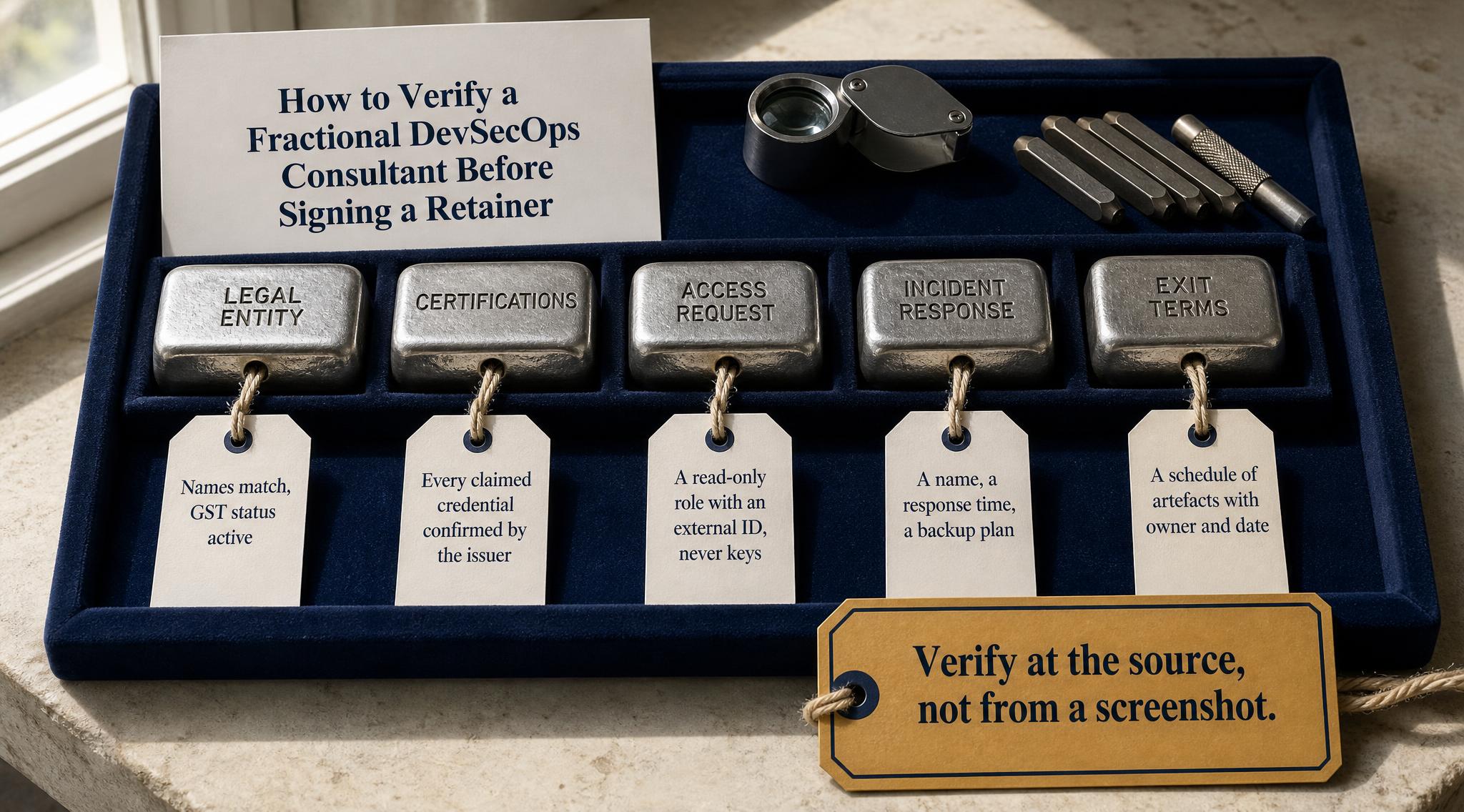
The question usually arrives as a full sentence: "how do i verify a fractional devsecops consultant is credible before signing a retainer". It comes from a founder or a first engineering lead who has already decided a fractional arrangement is the right shape, has a shortlist of one to three names, and is about to hand someone outside the company a role in their cloud account. The worry is reasonable. A fractional consultant gets more access in week one than most new hires get in month three.
Most answers to this question are written by the people being verified, so they ask you to check things the author happens to pass. This post tries to be useful even when the answer is not us. It lists ten checks, says where each one is verified (an issuer, a registry, a document, or a live conversation), and says what a pass looks like. Where I am giving a practitioner read rather than citing a source, it is labelled inline.
Disclosure. I run MatrixGard, a fractional DevSecOps practice, so I am one of the people you would be checking. MatrixGard is a young practice, which means some of these checks are ones it can only partly answer today. Where that is true, I say so inside the check and name the substitute evidence you should ask for instead.
Quick context: due diligence is now a documented practice, not a gut feel
Checking a supplier before signing used to be a large-company ritual. That changed. NIST released its finalized Cybersecurity Supply Chain Risk Management Due Diligence Assessment Quick-Start Guide in July 2026, explicitly aimed at teams with limited resources, and it frames due diligence as the minimum reasonable research and verification you do on a supplier before entering an agreement (NIST, C-SCRM Due Diligence Quick-Start Guide announcement). CISA publishes a short vendor questionnaire written for small and medium businesses, covering published security policies, vulnerability handling and asset management (CISA, assessing vendors and suppliers fact sheet).
Both are heavier than a ten person startup needs. What follows is the subset that matters when the supplier is one or two senior people holding credentials to production.
How do I verify a fractional DevSecOps consultant is credible before signing a retainer?
Verify four things at their source and test three in conversation. At the source: the legal entity on the government registry, each certification on the issuer's own verification page, a redacted sample deliverable, and the contract terms for data and exit. In conversation: how they ask for access, who answers during an incident, and who else pays them. A credible consultant passes most checks in under an hour and does not resent being asked.
1. The company exists, and it is the one on the invoice
Start with the cheapest check, because it catches the most basic failure: an invoice from an entity that is not the one you think you are contracting with, or from no entity at all.
For an Indian provider, the Ministry of Corporate Affairs portal offers a public master data lookup by company name, CIN or LLPIN. It returns the registered name, date of incorporation, company category, registered address and directors, and the basic view needs no login (Ministry of Corporate Affairs). If the provider bills GST, the GST portal's Search Taxpayer function checks a 15 character GSTIN and returns the legal name and whether the registration is active, cancelled or suspended (GST portal, Search Taxpayer). Check the status, not only that the number exists.
Three things should line up: the name on the proposal, the name on the registry, and the name on the GST record.
MatrixGard is registered as NASHSMATRIXGARD OPC PVT LTD, a One Person Company, so this check on us returns one director. That is the honest shape of a solo practice, and it is why check 7 below matters more for us than for a larger firm.
Takeaway: ten minutes on two government portals, before any technical conversation.
2. Certifications verified at the issuer, not from a screenshot
A certification logo on a website proves nothing. Every serious issuer runs its own verification route, and a consultant who holds the credential can give you what you need to use it in one message.
AWS Certification issues a 16 character validation number on each certificate, which anyone the holder shares it with can check at the public verification page (AWS Certification, general information). The Linux Foundation, which runs the CKA and CKS Kubernetes exams, verifies a certificate ID against the holder's name (Linux Foundation, certification verification). ISC2 runs a member verification lookup for credentials such as CISSP, which needs the holder's last name and member or certificate number; there is no public browsable directory (ISC2, member verification).
Practitioner opinion: treat certifications as a floor, not a ceiling. A current AWS or Kubernetes security credential shows the person passed a proctored exam recently. The useful signal is a mismatch: a claimed credential that the issuer cannot confirm is a reason to stop, whatever else looks good.
Takeaway: ask for the validation number or badge link for every credential on the proposal, and check each one yourself.
3. Public work you can read without asking
The best evidence of how someone thinks is work they published before they knew you existed. Writing, open source contributions, conference talks, answered questions in public forums, a technical blog with dates on it.
Practitioner opinion: read two pieces and ask yourself three questions. Does it cite sources you can check, or does it assert? Does it ever say "it depends, and here is the deciding factor", or is every answer a product? Does it admit a trade-off, or does every recommendation happen to be the thing being sold? Content that turns into a pitch by the second paragraph is a preview of every recommendation you will get on the retainer.
This is the check MatrixGard can answer most fully today: the MatrixGard blog is public, dated, and every post ends with a methodology note naming its sources. Judge it with the same three questions.
Takeaway: read before you meet; it changes the questions you ask in the call.
4. A redacted sample deliverable, not a capabilities deck
A deliverable shows you what you will actually receive every month. Ask for one redacted example of the main artefact of the engagement: an audit report, a findings register, a monthly review, a runbook.
Practitioner opinion: look for four things in it. Each finding names the resource, the risk and the fix, not a category. Severity is ranked, so you can tell what to do on Monday. The fix is concrete enough that your own engineer could apply it. And the document would still make sense to someone who never spoke to the author, because that is the test it faces when the engagement ends.
If no sample can be shared because every past report belongs to a client, that is a fair answer. The substitute is a paid, scoped piece of work on your own estate before you commit to a retainer, which produces a real deliverable on your systems rather than a redacted one on someone else's.
Takeaway: the sample is the closest thing you will get to seeing month three in advance.
5. How they ask for access is the strongest live signal
This is the single check I would keep if I could keep only one, because it tests practice rather than claims, and it happens before anything is signed.
On AWS, a third party should get into your account through an IAM role that you create in your account and that they assume. AWS documents why the role's trust policy should carry an external ID issued by the vendor: without it, anyone who learns your role ARN could use the vendor as a confused deputy to reach your resources (AWS IAM, the confused deputy problem). AWS's IAM best practices also recommend temporary credentials over long-term access keys wherever possible (AWS IAM, security best practices).
So a credible consultant asks for a role, read-only to begin with, and tells you exactly which permissions it carries and why. A consultant who asks for an IAM user with access keys, an administrator login, or the root email has told you how they will treat the rest of your account. MatrixGard's published terms say the same thing in plain words: NDA before the discovery call, read-only access first, write access only when a specific fix needs it, removed at the end (MatrixGard, how we work).
Takeaway: ask "how will you access our account in week one?" and listen for the word role.
6. Who else will touch your data
A fractional practice may use subcontractors, offshore support or tooling that copies your configuration out of your account. Ask, in writing, who will have access and which tools will read your environment.
For an Indian startup this is not only a security question. Under section 8 of the Digital Personal Data Protection Act, 2023, a data fiduciary may engage a data processor to process personal data on its behalf only under a valid contract, and the fiduciary remains responsible for compliance across what is done on its behalf (DPDP Act 2023, section 8 text). Law-firm commentary reads the contract as the mechanism that carries those obligations down to the processor, and notes the Act does not prescribe a clause-by-clause template (King Stubb and Kasiva, data processing agreements under the DPDP Act).
Practitioner opinion: if the consultant will see production data, logs with personal data in them, or database snapshots, the retainer needs processing terms. A credible provider either has a standard set or is willing to sign yours.
Takeaway: a named list of people and tools, and processing terms if personal data is in reach.
7. The incident clock: who answers, and how fast
A retainer is partly a promise about the worst day. Find out what happens on it before you need it.
Indian startups have a hard external clock here. CERT-In's directions of 28 April 2022, issued under section 70B of the IT Act, require service providers, intermediaries, data centres and body corporates to report specified cyber incidents to CERT-In within six hours of noticing them or being told about them, and they took effect on 27 June 2022 (Trilegal, 2022 CERT-In directions). Whoever holds the security role has to be able to help you meet that.
Ask three things. Who, by name, answers at 2am on a Sunday? What is the written response time for a production-down incident versus an urgent one? And what happens when that person is on a flight or ill? A one or two person practice should answer the last question with a specific arrangement, not a reassurance.
For MatrixGard the honest answer is that I am the person, the published terms commit production-down response on every plan at any hour, and incident hours are priced openly on the pricing page. The single-person dependency is real, so the fix is on paper: runbooks your own engineers can follow without me, written as part of the work. The handover artefacts post lists them.
Takeaway: a name, a response time in writing, and a plan for when that name is unavailable.
8. Who else pays them
Some providers earn from the tools they recommend, through reseller margin, referral fees or partner incentives, and you should know before they recommend anything.
Partner tiers can be checked, with one caveat. AWS describes its services partner tiers (Select, Advanced, Premier) and what each requires (AWS, services partner tiers), and only partners at Select tier or above appear in the public partner directory. AWS's own guidance to partners also notes that parts of a listing are self-reported by the partner rather than populated by AWS (AWS APN blog, managing your partner listing). So a tier is evidence of a relationship with AWS, and the descriptive text next to it is still the partner's own words.
Practitioner opinion: ask directly, "do you earn anything from any tool or service you might recommend to us?" A credible answer is specific.
Ask MatrixGard the same question. The one commission arrangement it publishes is its own referral terms, which pay people who introduce a client, so that money flows out of the practice rather than in from a tool vendor.
Takeaway: one direct question, asked before any tooling recommendation lands.
9. References, and the substitute when a practice is new
A reference call is still useful: ask a past client what the consultant got wrong and how they handled it, because everyone can describe what went right.
Practitioner opinion: references are the weakest check on this list on their own. They are chosen by the provider, they cannot be verified independently, and a newer practice will have few or none. MatrixGard is in that position, with no retainer references to offer yet, so here is what to do instead, with us or with anyone in the same position.
Buy a small, fixed-scope engagement first and judge the work directly. Two conditions make it a real test: the deliverable stays with you whether or not you continue, and the price is low enough that a bad result is a cheap lesson. MatrixGard's version is the Full Audit at $1,500 or ₹15,000: two days, a written report with every finding ranked by severity, a money-back guarantee on findings, and the fee credited in full against a first retainer month if you continue (MatrixGard pricing). Whoever you choose, a paid first piece of work on your own systems tells you more than any reference call.
Takeaway: a small paid engagement on your own estate is the reference that cannot be curated.
10. The exit is agreed before the entry
The last check is in the contract. A credible consultant is comfortable agreeing, before starting, exactly what you keep when the engagement ends: infrastructure code in your repository, state in your account, access as a role you can delete, a runbook per alert, and a handover window.
Ask for the exit clause in the first draft of the contract, not the last. If the provider has never been asked for one, propose a schedule of artefacts with an owner and a date. The nine artefacts post lists what to name and the test for each.
Practitioner opinion: resistance to an exit clause is the clearest red flag on this list, because the business model it protects is your dependency.
Takeaway: if you would not be comfortable ending the engagement next month, do not sign it this month.
The ten checks, where to verify each, and what a pass looks like
| Check | Where it is verified | What a pass looks like |
|---|
| Legal entity | MCA master data, GST Search Taxpayer | Names match, GST status active, a director you have met |
| Certifications | Each issuer's verification page | Every claimed credential confirmed by the issuer |
| Public work | Their own blog, code, talks | Sourced, dated, admits trade-offs |
| Sample deliverable | A redacted report, or your own paid audit | Findings named, ranked, fixable by your engineer |
| Access request | The first technical conversation | A read-only role with an external ID, never keys |
| Data handling | Written list, processing terms | Named people and tools, DPDP-ready contract |
| Incident response | Written terms | A name, a response time, a backup plan |
| Incentives | A direct question, partner directory | A specific answer, disclosed before recommendations |
| References | Calls, or a small paid engagement | Work judged on your own estate |
| Exit terms | The first contract draft | A schedule of artefacts with owner and date |
What to insist on at your stage (practitioner opinion)
Pre-seed, under ten people. Five checks: the legal entity, the access request, the incident name and response time, the exit clause, and a small paid first engagement in place of references.
Seed, with paying customers and a first security questionnaire. Add certifications at the issuer, the data handling list, processing terms and the incentives question.
Series A, or regulated from the start. All ten, written into the contract, and repeated at renewal. At this stage use the NIST quick-start guide and the CISA questionnaire cited above as your template.
If you are weighing a fractional provider now, MatrixGard runs a free 20-minute review for early-stage founders, funded or bootstrapped. Bring the shortlist, including us, and we will walk through how each check applies to your situation. Start with the security checklist.
Avinash S is the founder of MatrixGard. Fractional DevSecOps for early-stage startups, funded or bootstrapped across India, the GCC, the UK, and the US. Almost a decade of building, breaking, and securing cloud infrastructure for fintech, healthtech, and SaaS workloads.
Methodology note. This post answers how do i verify a fractional devsecops consultant is credible before signing a retainer as a list of checks, each tied to where it is verified, and does not cite any engagement of ours. The due diligence framing is from NIST's July 2026 C-SCRM Due Diligence Quick-Start Guide announcement and CISA's small business vendor fact sheet. Registry lookups are from the MCA and GST portals; certification verification routes are from AWS Certification, the Linux Foundation and ISC2. Cross-account access guidance is from the AWS IAM confused deputy and best practices pages. The DPDP reference is section 8 of the Act, with the reading of the contract requirement attributed to law-firm commentary. CERT-In reporting obligations are as summarised by Trilegal; check the directions text before relying on them. AWS partner tier and listing details are from AWS's own pages. MatrixGard's entity type, prices and access terms are from its own published pricing and how-we-work pages. The check list, the weighting of checks and the stage sequencing are practitioner opinion. No client outcome, price other than MatrixGard's published ones, or testimonial appears in this post.