GitHub Incident on 11 November 2026: What Failed and What Teams Should Check
Our recommendation: treat Actions, Pages, Webhooks and Copilot as correlated dependencies and maintain independent checks for critical delivery paths.
Affected: GitHub reported an incident affecting Webhooks, Actions, Pages and Copilot.
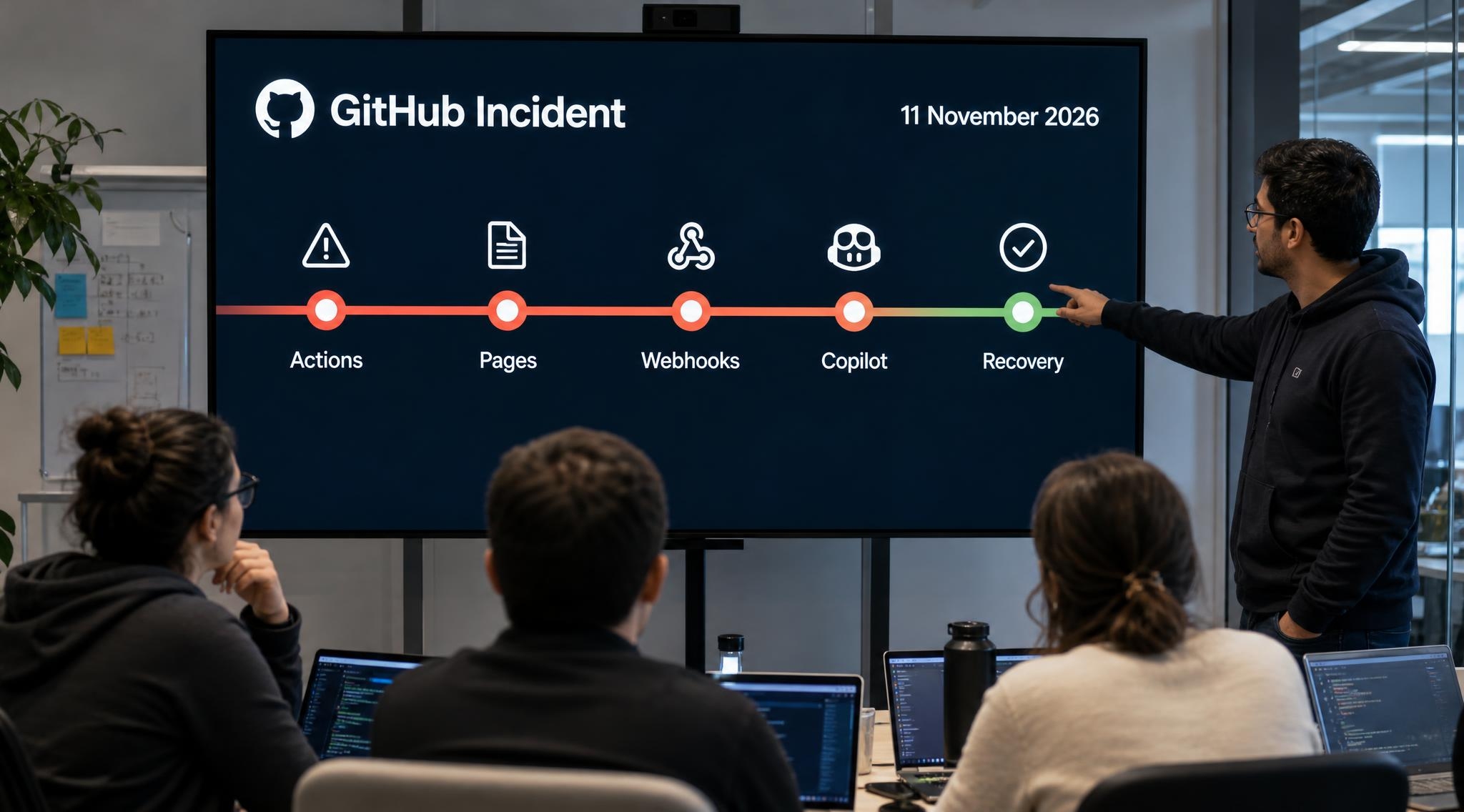
What happened?
GitHub reported an incident on 11 November 2026 affecting Webhooks, Actions, Pages and Copilot. The first status updates at 20:48 UTC reported degraded availability for Pages and Actions, while Webhooks was experiencing degraded performance.
At 20:56 UTC, GitHub said it was investigating issues impacting multiple products including Actions, Pages and Copilot products. At 20:57 UTC, GitHub separately reported degraded availability for Copilot.
By 21:07 UTC, GitHub said the degradation affecting Actions, Copilot, Pages and Webhooks had been mitigated and that it was monitoring for stability. GitHub also said an Actions job backlog was being processed. At 21:21 UTC, GitHub reported that the backlog had been fully processed, said it was observing full recovery across all impacted services, and marked the incident resolved.
GitHub said a detailed root cause analysis would be shared later. That means the status page confirms the service impact and recovery sequence, but it does not yet provide the underlying technical cause.
Which workflows?
The affected GitHub components named on the incident page were Webhooks, Actions, Pages and Copilot. That matters because a team can depend on several of these products in the same delivery path.
Our recommendation: map which production workflows depend on each GitHub component. Separate source control from automation, webhook delivery, hosted Pages deployment and Copilot-assisted work in that map. Do not assume that a green repository page proves every dependent workflow is healthy.
Our recommendation: for Actions, keep a check that can tell you whether jobs are starting, queueing or completing. For Webhooks, monitor whether expected events reach your own endpoint. For Pages, verify the deployed site from outside GitHub. For Copilot, treat availability as a productivity dependency rather than a deployment control unless your own process makes it one.
Cause per provider?
The incident page does not state a root cause. GitHub's resolved update says a detailed root cause analysis will be shared when available.
Our recommendation: do not invent a network, capacity, deployment or third-party explanation before GitHub publishes its analysis. Record the confirmed timeline now, then update the incident record when the provider publishes the cause.
Our recommendation: keep your internal incident notes separate from the provider's eventual root cause. Your own failure mode may be a queued workflow, a missed webhook, an unavailable Pages deployment or lost developer productivity even when all of those symptoms come from one provider incident.
How to cut the impact of a repeat?
Our recommendation: identify the business-critical GitHub-dependent paths first. For each path, define one independent signal that does not rely on the same GitHub component you are checking.
Our recommendation: keep deployment artefacts and recovery instructions somewhere your responders can still reach during a GitHub service incident. Decide in advance which releases can wait and which need an alternate process. If a webhook triggers a critical downstream action, add reconciliation so a delayed or missed event can be detected after service recovery.
Our recommendation: after recovery, check for queued or delayed automation rather than assuming mitigation means all pending work has completed. GitHub's own updates distinguished mitigation from the later completion of the Actions backlog.
Our recommendation: subscribe the engineering team to provider incident notifications and link provider incidents to your internal incident records. The useful lesson is not to duplicate GitHub. It is to know which parts of your delivery system stop working when several GitHub services degrade together.
Sources
- Impact across multiple GitHub products including Actions, Pages, and Copilot products. (GitHub, 11 Nov 2026). Primary source.