AWS CloudWatch Logs Account-Level Retention Policies (November 2026): What Startups Need to Know
Our recommendation: Adopt account-level policies when their scope and overlap rule match your retention requirements, after checking regional availability.
Affected: Platform and security teams managing retention for Amazon CloudWatch Logs log groups in AWS accounts are affected.
What did the vendor release?
On 9 November 2026, AWS announced account-level retention policies for Amazon CloudWatch Logs. A single policy can set how long log data is kept across all or a subset of log groups in an AWS account.
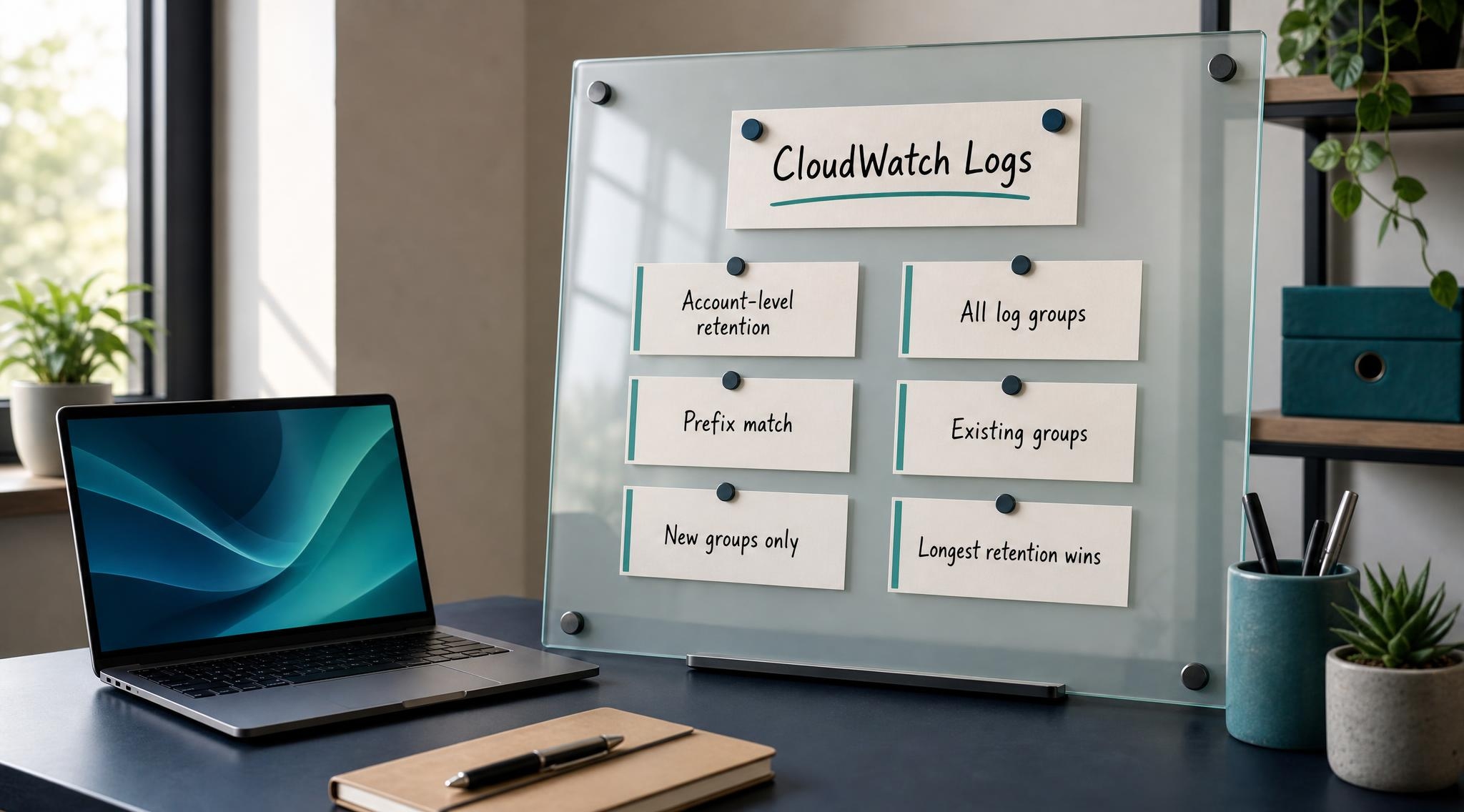
Policies can cover all log groups or groups with names that start with a prefix, such as /aws/lambda. You can choose whether a policy applies to existing log groups or only new ones. When multiple policies match a log group, the longest retention period applies.
The feature is available in all commercial AWS Regions except Middle East (Bahrain) and Middle East (UAE), at no additional cost. You can create and manage up to 20 policies per account and region through the AWS Management Console, AWS CLI and AWS SDKs.
Which startups are affected?
Account-level policies allow platform and security teams to align log groups with their retention standards.
Our recommendation: Review this release if your startup uses CloudWatch Logs and wants shared retention rules across an account or groups with related names. Start with the retention periods you have agreed for each type of log, then check whether your group names provide a suitable prefix.
Our recommendation: Involve whoever owns the logs and whoever approves retention requirements. For a small team, make the decision explicit: which groups belong together, which require a separate retention period, and whether the first policy should include existing groups or only new ones.
Adopt it or keep the existing approach?
AWS gives an example of a 90-day account baseline and a one-year policy for log groups whose names start with /security. The example combines these policies without tracking individual log group names.
Our recommendation: Adopt this approach when the scope across the account or selected name prefixes matches your approved retention requirements. Review overlap before choosing periods. Check that the longest applicable period is acceptable for every group covered by more than one policy.
Our recommendation: Keep your current approach while retention requirements or naming boundaries remain unclear. Avoid choosing the example periods simply because AWS uses them. Agree your own periods, document exceptions and identify an owner before changing coverage.
What to check before enabling it?
Our recommendation: Prepare a short rollout record with the proposed policy scope, retention period, owner and validation steps. Use the following checks to decide whether the change is ready.
- Our recommendation: List the accounts and regions involved. Confirm feature availability for each region and plan within the limit of 20 policies per account and region.
- Our recommendation: Review the full set of log group names matched by each proposed prefix. Check that each included group belongs under the chosen retention rule.
- Our recommendation: Choose explicitly between applying the policy to existing log groups and only new ones. Have the log owner review the selected scope before enabling it.
- Our recommendation: Map overlapping policies and record the longest matching retention period for each affected group. Confirm that the resulting period matches the intended requirement.
- Our recommendation: Use a limited initial scope and verify the resulting retention settings before expanding coverage. Record the previous settings and a recovery plan before making changes.
- Our recommendation: Assess any cost expectations separately. Treat the announcement's statement about no additional cost as applying to the account-level policies, and validate any forecast of lower spending before relying on it.
Sources
- Amazon CloudWatch Logs announces account-level retention policies (AWS, 9 Nov 2026). Primary source.