AWS Cloud WAN Flow Logs (November 2026): What Startups Need to Know
Our recommendation: adopt Cloud WAN Flow Logs when central network visibility would reduce fragmented log collection, but define scope, destination and retention before enabling them broadly.
Affected: Teams operating AWS Cloud WAN core networks can now collect Flow Logs centrally instead of relying only on logs gathered from individual connected networks.
What did the vendor release?
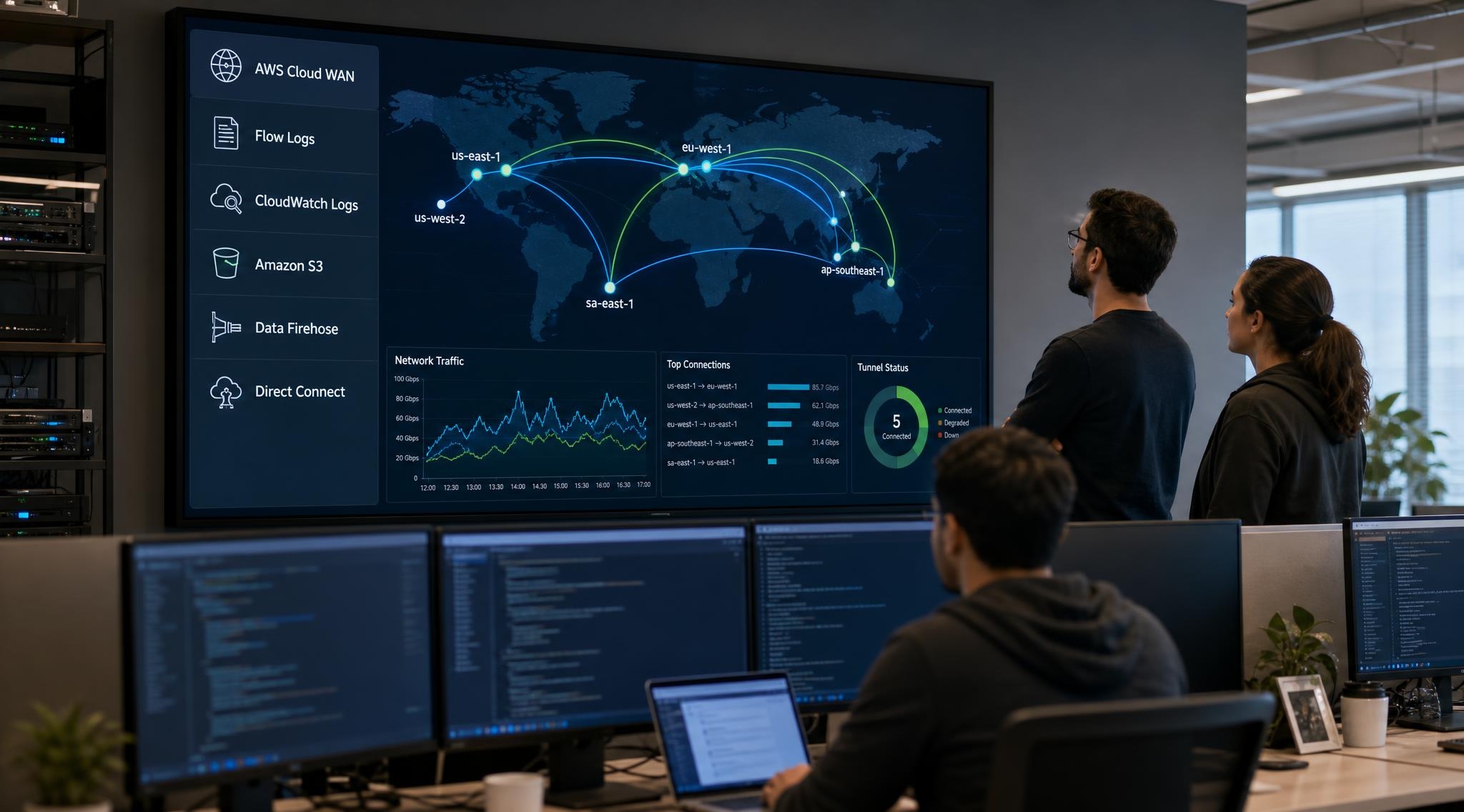
AWS announced Cloud WAN Flow Logs on 11 November 2026. AWS Cloud WAN now supports VPC Flow Logs and gives core network owners central visibility into IP traffic across a global network. Before this release, network administrators had to stitch together VPC Flow Logs from multiple VPCs, accounts and Regions, and could depend on other teams for access.
Cloud WAN Flow Logs provide a consolidated view of traffic between VPCs, Regions and on-premises networks connected through AWS Direct Connect, AWS Site-to-Site VPN or SD-WAN. AWS says the data can be used to troubleshoot connectivity and performance issues, plan capacity from historical bandwidth trends, identify unusual traffic patterns, and retain records for security and compliance.
Flow log records can include IP addresses, ports, protocol, traffic volume and packet-loss counters, plus Cloud WAN metadata such as segment, Region, service insertion hops and attachment details.
Our recommendation: view this as an observability consolidation feature, not as a reason to enable maximum logging everywhere on day one. Start by deciding which operational or security questions the logs need to answer.
Which startups are affected?
The feature can be enabled for an entire core network, a single core network edge, or individual attachments. That makes it relevant to teams already using Cloud WAN and needing visibility at different parts of the core network.
Our recommendation: startups with a small network should avoid turning broad collection into a default simply because the feature exists. Choose the smallest scope that answers the problem you are investigating. Teams with a more distributed network can consider broader coverage where central visibility meaningfully reduces operational handoffs.
Our recommendation: if engineers currently spend time requesting logs from account owners or combining logs from several locations, test whether Cloud WAN Flow Logs simplify that workflow. Keep the evaluation focused on fewer manual handoffs, faster troubleshooting and clearer ownership rather than adding another telemetry stream without an operating purpose.
Adopt it or keep the existing approach?
Cloud WAN Flow Logs can publish to Amazon CloudWatch Logs, Amazon S3 or Amazon Data Firehose. AWS states that Cloud WAN itself adds no charge for Flow Logs, while standard charges apply to the selected destination.
Our recommendation: adopt the feature where consolidated Cloud WAN visibility replaces a fragmented collection process or provides information that your current approach does not expose conveniently. Keep the existing approach where it already meets operational needs and another log stream would only duplicate data.
Our recommendation: treat destination choice as an architecture decision. Pick the destination according to how the data will actually be searched, retained, forwarded or analysed. Do not select a destination merely because it is the fastest option to enable.
Our recommendation: run a narrow pilot first. Choose one meaningful attachment or edge, confirm the records contain the fields your team needs, and verify that the destination behaves as expected before expanding collection.
What to check before enabling it?
Cloud WAN Flow Logs are available in all AWS Regions where AWS Cloud WAN is available, and AWS says they can be configured through the AWS Management Console, AWS CLI or API.
Our recommendation: document the intended logging scope, destination, retention approach and operational owner before rollout. Confirm who will investigate unusual traffic, who controls access to the destination, and what event should justify expanding from an attachment or edge to the full core network.
Our recommendation: review destination costs separately from the statement that Cloud WAN adds no charge for Flow Logs. The release explicitly says standard destination charges still apply, so the useful cost question is how much data your selected scope will send to CloudWatch Logs, S3 or Data Firehose.
Sources
- AWS Cloud WAN now supports Flow Logs (Amazon Web Services, 11 Nov 2026). Primary source.