Amazon OpenSearch Service Managed Cross-Region Disaster Recovery (November 2026): What Startups Need to Know
Startups that need cross-Region OpenSearch recovery should evaluate the managed option before continuing to build and maintain replication themselves.
Affected: Teams running Amazon OpenSearch Service search, AI or analytics workloads that need cross-Region availability and business continuity are affected.
What did the vendor release?
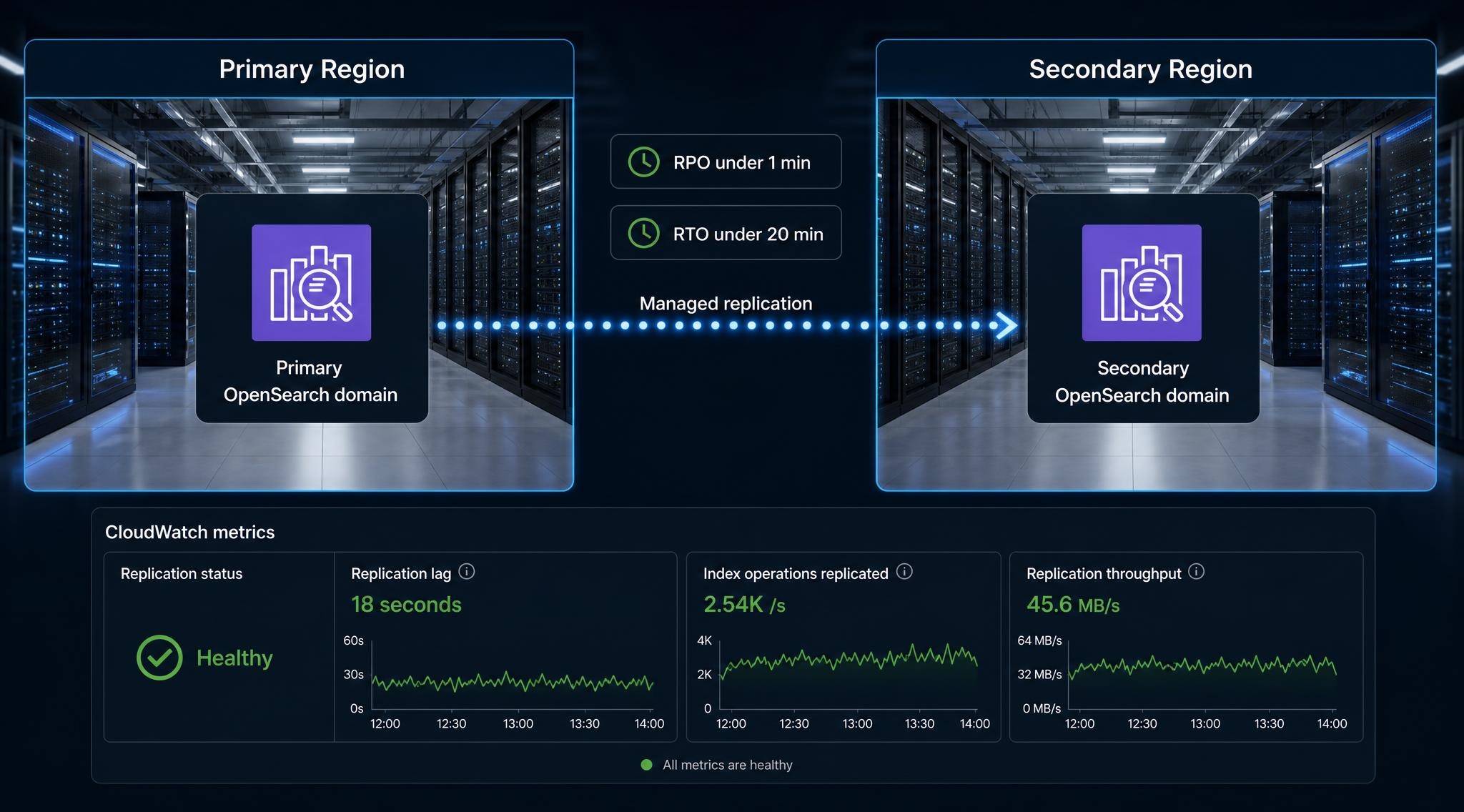
Amazon OpenSearch Service now offers managed cross-Region disaster recovery for search, AI and analytics workloads. AWS says the feature is intended to meet strict availability and business continuity requirements without customers building or maintaining replication themselves. After creating domains in two Regions, you can pair them with a single API call or through a few steps in the AWS Management Console.
The managed service provides a recovery point objective of under one minute and a recovery time objective of under 20 minutes. The secondary domain remains continuously in sync with the primary. For planned maintenance or Region rotation, a switchover exchanges the roles of the two domains with zero data loss. If the primary becomes unavailable, a failover promotes the secondary, with data loss limited to replication lag.
After failover, AWS says protection is restored by pairing the new primary with a secondary domain. Replication health and lag can be monitored with Amazon CloudWatch metrics.
Which startups are affected?
The change matters to teams already using Amazon OpenSearch Service where cross-Region availability or business continuity is a requirement. It is especially relevant when the workload is important enough that teams are considering replication across Regions but do not want to build or maintain that replication themselves.
There are clear technical limits. Managed disaster recovery requires OpenSearch 3.7 or later. It supports domains in the same AWS account and includes domains encrypted with customer managed AWS Key Management Service keys. Domains using UltraWarm storage are not supported. OpenSearch Optimized OR1 and OR2 instances are also not supported.
If a domain is on an earlier OpenSearch version, AWS says clone-based upgrades can be used to test OpenSearch 3.7 against the workload. The upgrade process can then cut over when ready and roll back if needed.
Adopt it or keep the existing approach?
There is no additional charge for the managed disaster recovery feature itself. Customers still pay standard rates for the secondary domain and for cross-Region data transfer. The capability is available in all commercial AWS Regions where Amazon OpenSearch Service is available.
Our recommendation: If you already maintain custom cross-Region OpenSearch replication, compare that operational work with the managed feature before investing further in the custom path. The managed option has explicit RPO and RTO targets from AWS, but it also requires a second domain and cross-Region transfer costs.
Our recommendation: Do not treat the absence of an additional feature charge as meaning disaster recovery is free. Model the secondary domain and cross-Region transfer costs before enabling it. If your existing domain uses UltraWarm, OR1 or OR2, the managed option is not currently available to that domain.
What to check before enabling it?
First, confirm the OpenSearch version. The managed feature requires OpenSearch 3.7 or later. If you are on an earlier version, use the clone-based upgrade path described by AWS to test 3.7 against the workload before cutting over.
Second, check the domain configuration. UltraWarm storage and OpenSearch Optimized OR1 or OR2 instances are not supported. Domains in the same AWS account are supported, including domains encrypted with customer managed AWS KMS keys.
Third, calculate the cost of keeping the secondary domain running and transferring data across Regions. AWS charges no additional fee for the managed disaster recovery feature, but standard secondary-domain and cross-Region data-transfer rates still apply.
Our recommendation: Before production use, document who can initiate switchover or failover, monitor the CloudWatch replication health and lag metrics, and test the operating procedure your team will use after failover to pair the new primary with a secondary domain.
Sources
- Amazon OpenSearch Service announces managed cross-Region disaster recovery (Amazon Web Services, 10 Nov 2026). Primary source.