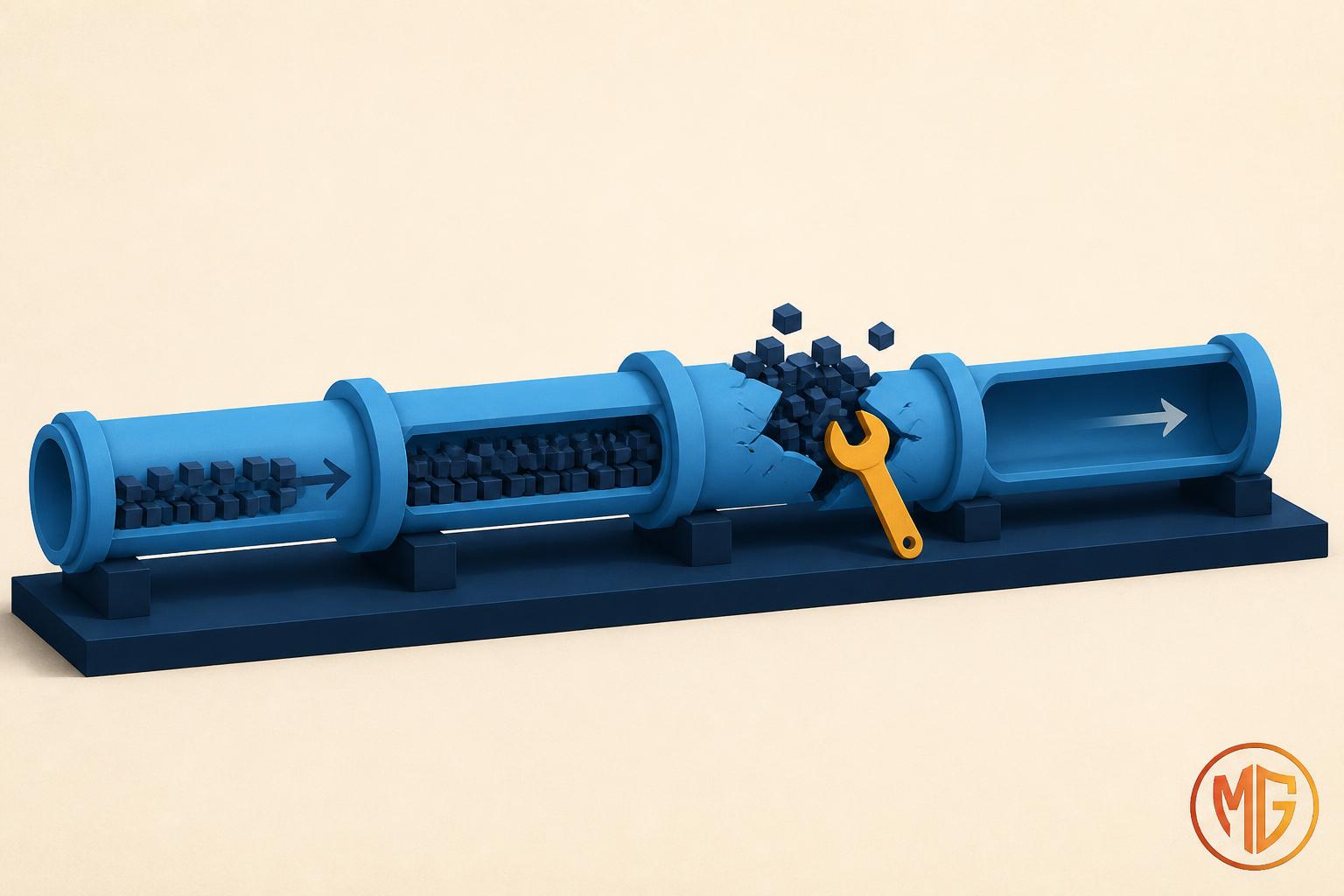
Nobody decided that a senior engineer would spend a third of the week babysitting the pipeline. It happened one broken build at a time, and because the work is invisible in the roadmap, it never gets budgeted, argued about, or fixed. It just quietly becomes somebody's second job.
The first move is not a tool. It is making the cost visible enough to act on.
Measure the tax, roughly, for one week
Ask the team to note two numbers for five working days: minutes spent on anything deployment-related that was not planned work, and how many times a deploy needed a second attempt. Rough is fine. Precision is not the point; the point is that a number exists.
Two things usually come out of that week. The total is larger than anyone guessed, and it is concentrated in one or two people who had stopped mentioning it.
Once you have the number, the rest of this is an ordinary prioritisation question rather than a vague complaint.
Where the time actually goes
Flaky tests. The single biggest source in most small teams. A suite that fails randomly trains everyone to re-run rather than read, which means real failures get re-run too. The cost is not just the reruns; it is that the pipeline stops being trusted, and an untrusted pipeline gets bypassed.
Environments that do not match. It works in staging and fails in production, so every deploy becomes an investigation. The gap is usually configuration, data shape, or a dependency version rather than anything architectural.
Manual steps in the middle. A migration someone runs by hand, a flag flipped in a console, a cache cleared. Each is small, each must be remembered, and the deploy fails in a new way whenever it is not.
Slow feedback. A pipeline that takes forty minutes to tell you about a typo means a whole afternoon lost to three mistakes. Long pipelines also encourage large batches, and large batches fail in more interesting ways.
No safe rollback. When going back is risky, every deploy carries the full weight of being right, so deploys get bigger, rarer and more frightening, which makes them fail more.
The fixes, cheapest first
| Fix | Effort | Why it pays |
|---|---|---|
| Quarantine flaky tests instead of re-running them | Hours | Move known-flaky tests out of the blocking path and fix them on a schedule. Restores trust in a red build immediately, which is the thing everything else depends on. |
| Make the pipeline fail fast | Hours | Lint and unit tests before anything slow. Most failures are cheap ones and should be reported in two minutes, not forty. |
| Delete the manual steps | Days | Every human step is a step that gets forgotten. Automating migrations and config changes removes a recurring class of failure rather than one instance of it. |
| Close the staging gap | Days | Same infrastructure definition, same config mechanism, realistic data shape. Turns "works on staging" from a hope into evidence. |
| Make rollback boring | Days | When going back is one command and no drama, deploys get smaller and more frequent, and smaller deploys fail less. |
| Give the pipeline an owner | Ongoing | Without one, entropy wins and you are back here in six months. This is the part a retainer or a hire actually buys. |
The trap worth avoiding
The common response is to replace the CI tool. It feels decisive and it rarely helps, because flaky tests, config drift and manual steps all migrate to the new tool intact. Change the tool when the tool is genuinely the constraint, which is far less often than it feels at 6pm on a Friday.