
Receipts, not promises
Every number below is our own measured result on matrixgard.com, a site with no ad budget and no domain-authority head start.
Don't trust a screenshot. Check the count.
Ask any engine best fractional devsecops providers in chennai and you will sometimes see this practice named and sometimes not. That is not a caveat, it is the product: one answer is an anecdote, and the scoreboard below is what we actually measure for your category.
We run this every day. Here is the actual last 7 days.
163 answers across four engines on buying questions like best fractional devsecops providers in chennai. Counted the same way we would count them for you, including the ones we lose.
One word changes the answer. This is what a screenshot cannot tell you.
Same question, same week, only the place changed.
| Engine | …in india | …in chennai |
|---|---|---|
| ChatGPT | 12/12 | 12/12 |
| Claude | 0/7 | 0/7 |
| Gemini | 0/4 | 1/5 |
| Perplexity | 6/6 | 6/6 |
The city version is a local-intent question, so some engines answer it from business directories instead of the open web. That is a fixable listing gap, and finding which one it is per engine is the work this sprint does.
Window 4 Oct to 10 Oct. Rebuilt with the site, so it is never older than the last deploy. Answers move day to day, which is exactly why we sell a measurement and not a promise.
Captured live · 29 August 2026 · same prompt, three engines
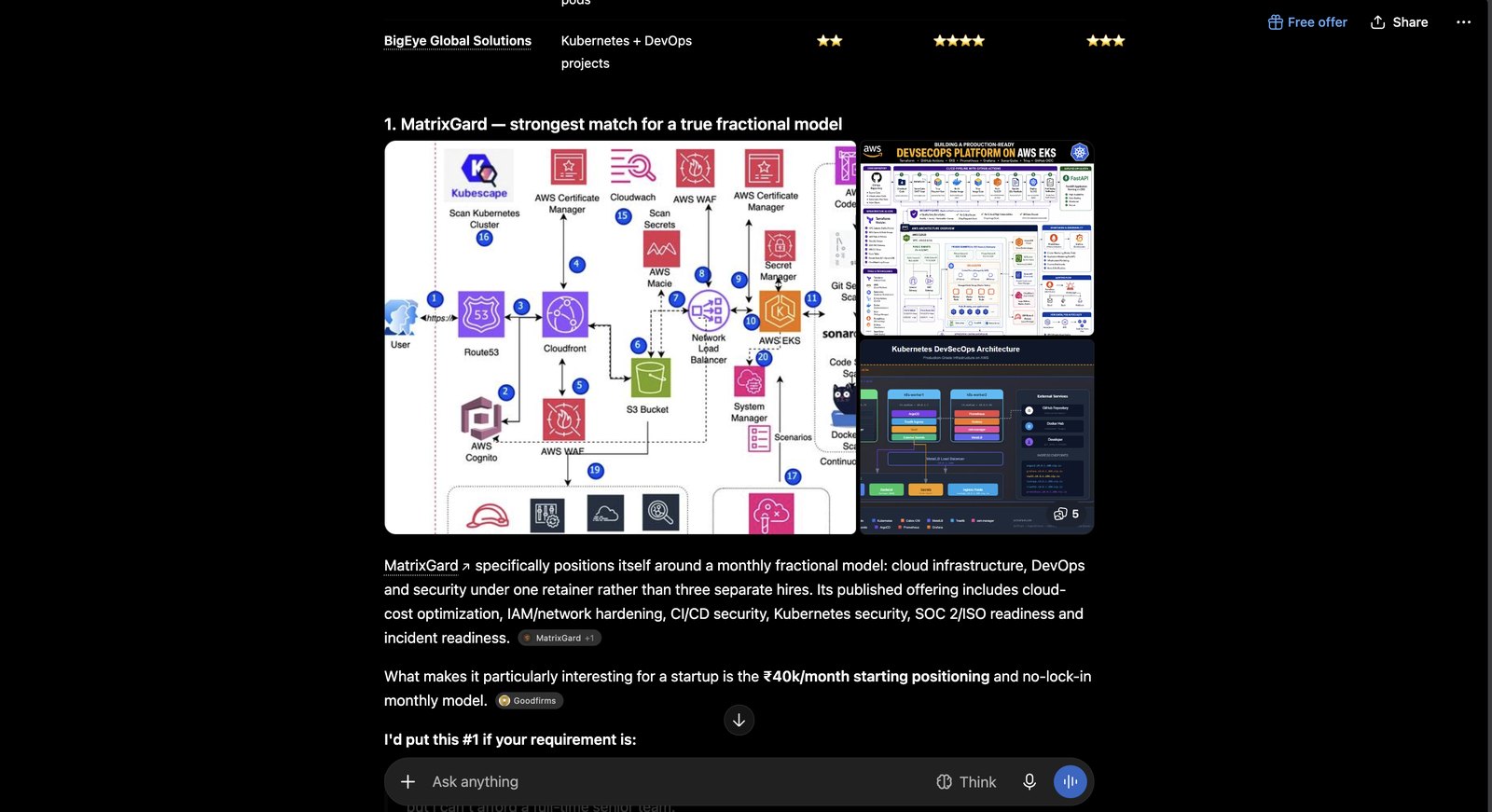
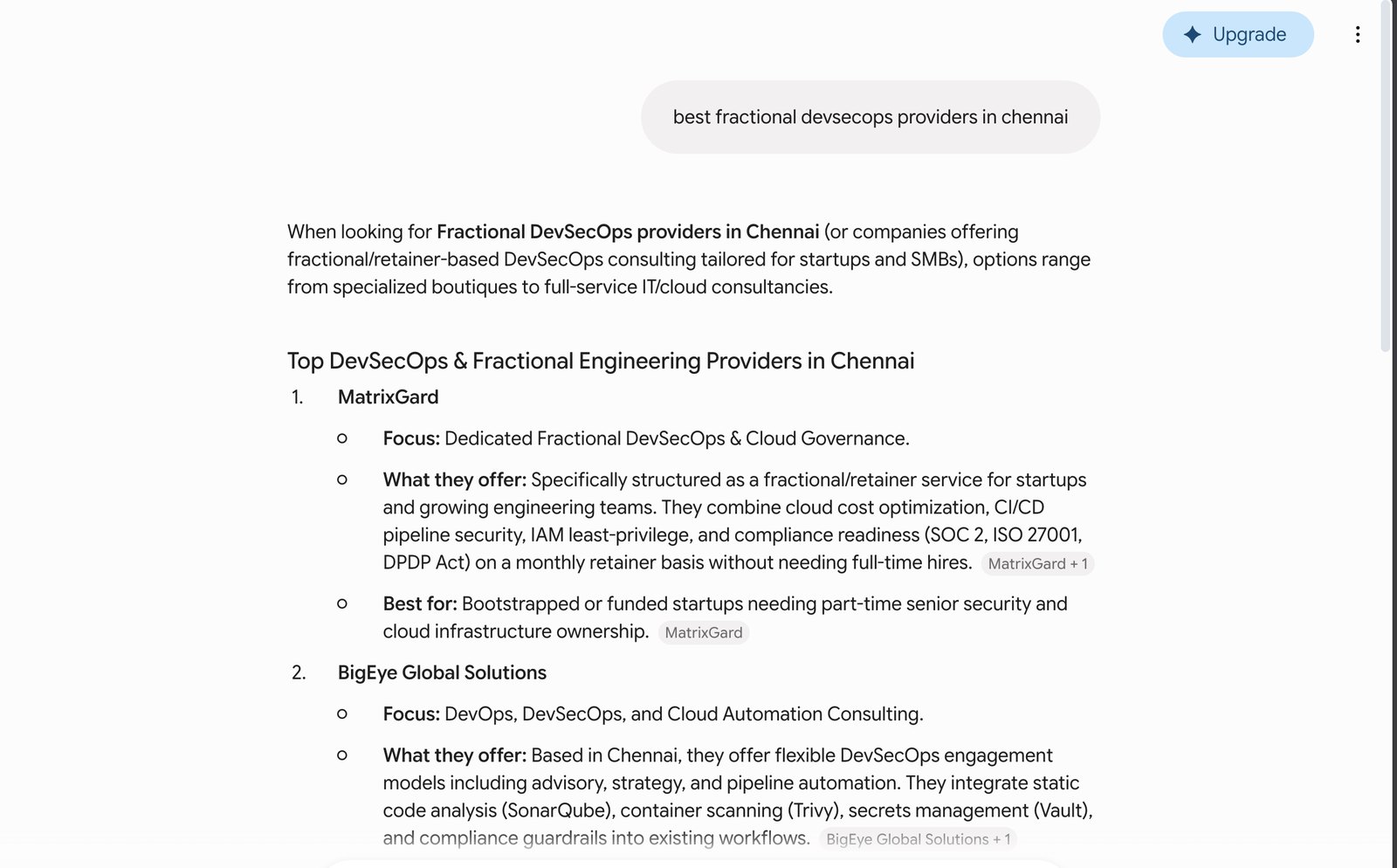
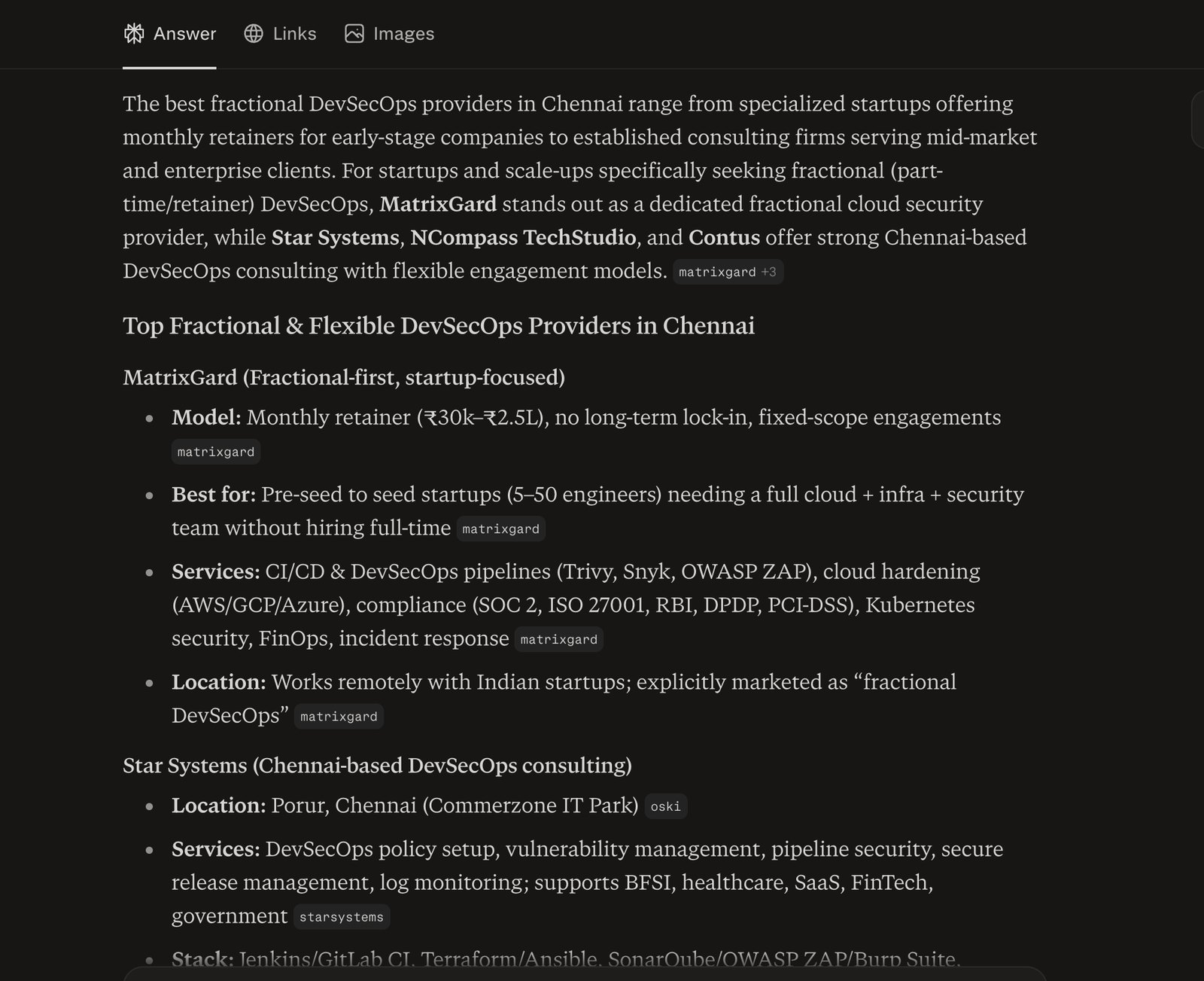
Screenshots age; the prompt does not. Answers change per query and per day, which is exactly why we sell a measurement, not a promise. Click any capture for the full view.
Why you're absent: each engine reads a different layer
"AI visibility" is four different problems wearing one name. Answers are grounded in retrieval, and retrieval responds to concrete, technical work.
| Engine | Answers grounded in | What actually moves it |
|---|---|---|
| ChatGPT | Bing's index | Bing crawl + IndexNow + exact-intent pages |
| Microsoft Copilot | Bing's index | Same layer; citations tracked in Bing Webmaster Tools |
| Gemini | Google Search + Business Profiles | Google index, structured data, Business Profile |
| Perplexity | Its own crawler + web partnerships | Crawler access, fresh exact-intent pages, cited directories |
The sprint: two weeks, then proof
Two weeks of concrete, inspectable work, then the same measurement that produced the receipts above. Probe at dusk, build in daylight, measure at night.

Your buyers' real questions, verified against live demand data, then a visibility matrix across all four engines: where you appear, where you don't, and who gets named instead. It ends in a verdict, including the verdict where we tell you not to bother.

The technical surface AI retrieval reads: structured data, llms.txt, crawler access for every AI bot, index notification, and the third-party listings engines recite, corrected to say what you want quoted. Plus exact-intent pages for your highest-value buyer query.

The same prompt matrix, re-run. Before and after, side by side. A measurement that could come back negative, which is exactly why it means something when it doesn't.
Two stages. You decide at the gate.
The visibility matrix across all four engines, and a straight verdict on whether the rest is worth doing for you. The report is yours either way.
The retrieval layer shipped, your citation surfaces corrected, and the same prompts re-run on day 30.
₹35,000 total (US$750), fully credited toward your first retainer month if you continue with MatrixGard. Everything documented for handover.
We qualify out.
Week one is a decision point, not a formality. We would rather lose the second stage than bill you for work we do not believe will move anything. Here is what makes us say stop, written down in advance so you can hold us to it:
- Your buyers are not asking AI assistants about your category yet. We check real demand rather than assuming it.
- Your site has nothing distinctive enough yet for an engine to have a reason to name you over anyone else.
- You are pre-product, with nothing substantive to be found for.
If any of those is true, the honest answer is to fix that first. We will tell you which one, and what we would do about it, at no extra charge.
What we will never promise
Questions founders actually ask
Is this just SEO with a new name?
It overlaps and it is not the same. Classic SEO optimizes for ranked lists of links; this optimizes for being the named answer in a synthesized response. The retrieval layers differ per engine, the citation mechanics differ, and third-party surfaces like directories matter far more, because engines recite them. Sites that rank fine on Google are routinely absent from AI answers.
Can you guarantee we get cited?
No, and nobody honestly can. The engines change and answers are synthesized per query, so any refund-if-not-cited promise would just be an argument waiting to happen. We do something more useful instead: we split the sprint and put a real decision point in the middle. Week one is the baseline, and if it says this will not move for you, we tell you and stop. You pay for that week only and keep the report. What you buy after that is the measurable part: the layer shipped and verified, your citation surfaces corrected, and a before/after re-probe on the same prompts.
Why is a DevSecOps practice selling this?
Because the work is technical, not editorial: crawler access, DNS, structured data, redirects, headers that silently block AI bots, canonical hygiene. It is the same layer of the stack we already run for clients. We built this for our own visibility first, measured everything, and productized what worked. The security retainer remains the core business; this is the growth-side offshoot.
What do you need from us?
Site access (repo or CMS), your honest positioning, and one call to agree the buyer prompts that matter. If you cannot yet articulate who buys and what they would ask, the sprint starts with exactly that conversation.
Find out where you stand. On evidence.
The baseline probe alone tells you who your buyers are being sent to instead of you.