If you are the CTO or the founding engineer at an Indian fintech, an NBFC, or any company that lends, holds deposits, or scores credit, there is a Reserve Bank of India directive that quietly governs almost every vendor contract you sign. Most teams meet it for the first time during a regulatory inspection or halfway through a due-diligence questionnaire from a bank partner, which is the worst possible moment to discover a gap.
The directive is the Master Direction on Outsourcing of Information Technology Services. Generic articles treat it as a legal checklist for the compliance team. That framing is why teams get caught. It is an engineering and procurement mandate first. It reaches your cloud provider, your CI pipeline vendor, your log aggregator, your KYC API, and your managed security service, and it dictates clauses those vendors do not put in a standard contract.
This post is a practitioner's implementation guide, grounded in the text of the Direction (notification RBI/2023-24/102, in force since 1 October 2023). It is not legal advice, and where I give an opinion on how to sequence the work I label it as such. The goal is that you can walk out of this with a concrete list of artifacts to build.
Quick context: what the Direction actually is
The Reserve Bank notified this Master Direction on 10 April 2023, with an effective date of 1 October 2023. It consolidates and hardens a decade of scattered outsourcing guidance into one binding instrument aimed squarely at IT. It exists because regulated entities now run on third-party technology: public cloud, SaaS, managed detection, offshore development. The regulator's organising principle is one sentence worth memorising. You can outsource the activity, you cannot outsource the accountability. Every clause below is a mechanism for keeping the regulated entity, and its board, on the hook no matter who runs the servers.
1. First work out whether it even binds you
Applicability is narrower than the panic suggests. Per the Direction's applicability section it covers commercial banks (excluding Regional Rural Banks), Small Finance Banks, Payments Banks, the Top, Upper and Middle layers of NBFCs, Credit Information Companies, and All India Financial Institutions. Notably, Base Layer NBFCs are excluded. So a small NBFC in the Base Layer is not directly bound.
Here is the trap that catches pure-software fintechs who assume they are exempt. If you partner with a bank or a larger NBFC to originate loans, issue cards, or hold funds, that regulated entity is bound, and it will flow every one of these obligations down to you through its own vendor contract. You inherit the Direction commercially even when you do not inherit it legally. Practitioner takeaway: before anything else, write down your own regulatory status and the status of every partner you route regulated activity through, because that map decides how much of this applies.
2. Not every vendor counts: classify material outsourcing
The Direction does not regulate every SaaS subscription. It targets material outsourcing of IT services, which its definitions section frames as arrangements whose disruption would materially affect business operations or that involve access to customer data. A design tool is out. Your core banking host, your cloud provider, and your KYC processor are firmly in.
The Direction is also explicit about what is not outsourcing. Appendix III lists exclusions, including services like vulnerability assessment and penetration testing, SMS gateways, and OEM maintenance of hardware, and it clarifies which parties are not treated as third-party service providers. This matters because it stops you over-scoping the register and drowning in paperwork for vendors the regulator never intended to capture. Practitioner takeaway: build a vendor register and put a single materiality flag on each row. That one column determines which vendors pull in the full contractual and audit machinery below, and which ones you can note and move on from.
3. The board-approved policy is the anchor artifact
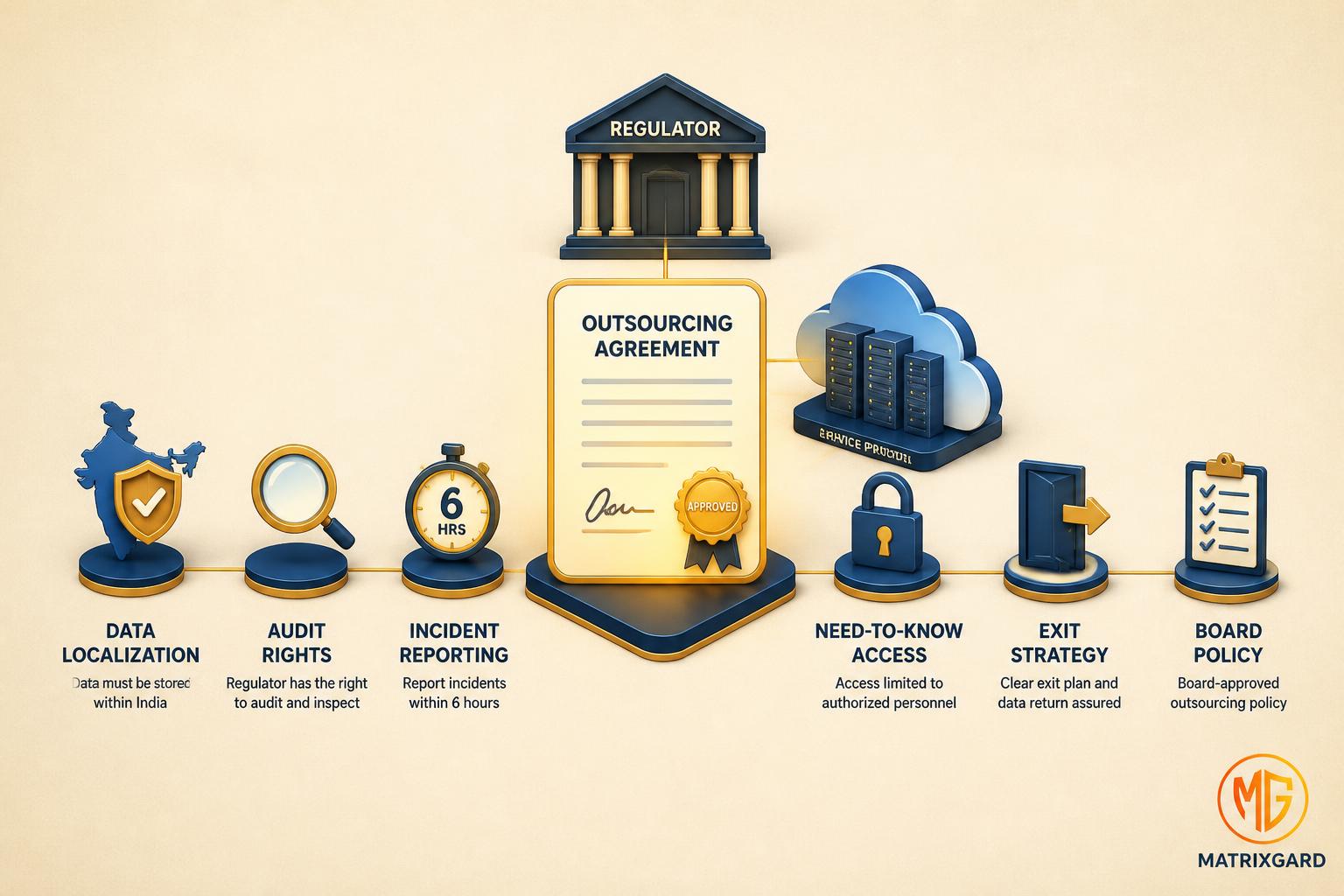
Chapter III is where the accountability principle becomes structure. Section 9 requires a comprehensive board-approved IT outsourcing policy covering selection criteria, materiality thresholds, delegation of authority, disaster recovery, monitoring, and termination. Section 10 puts the framework's approval and risk evaluation on the board itself. Section 11 hands senior management the operational load: formulating policy, reporting outsourcing risk upward, and ensuring business continuity plans are tested periodically.
Section 12 is the one engineers should care about most. It requires the IT function to maintain a central database of all outsourcing arrangements. When an inspection arrives, this register is the first artifact requested, and its completeness signals whether your governance is real or theatre. Practitioner takeaway: do not treat the policy as a document that lives in a drive and is never opened. The living register of arrangements, with owner, materiality, contract dates, and last review, is the operational heart of compliance. Wire it to your procurement process so a new material vendor cannot go live without a row.
4. Due diligence has to be documented, not felt
Chapter IV converts vendor selection from a gut call into an evidenced process. Section 13 mandates a risk-based assessment weighing qualitative, quantitative, financial, operational, legal, and reputational factors, supported by independent reviews and market feedback. Section 14 then enumerates the specific aspects to evaluate, a list that runs to more than a dozen elements including financial soundness, technology infrastructure stability, data segregation capability, the quality of the provider's own vetting of its employees and sub-contractors, and its cybersecurity posture.
The engineering-relevant point is that a vendor's marketing page is not diligence. A SOC 2 report, a penetration test summary, an architecture review, and a check on data segregation are. Practitioner takeaway: keep a dated diligence file per material vendor and refresh it on a cadence, not once at signing. The Direction expects diligence to be ongoing, and an inspector who finds a five-year-old assessment for a business-critical provider will read that as a control gap.
5. The 23 contract clauses most standard MSAs are missing
Chapter V is the sharpest edge of the Direction and the section CTOs underestimate. Section 15 requires a legally binding written agreement structured to keep the regulated entity in control. Section 16 then lists the minimum provisions that agreement must contain, and there are more than twenty of them. A few that off-the-shelf vendor contracts almost never include: the entity's right to audit the provider and its sub-contractors; storage of data only in India; prior consent before a provider engages sub-contractors; a clear exit and transfer right; and, critically, a clause allowing the RBI or persons authorised by it to access the provider's systems and data.
Read that last one again, because it is the clause that breaks the most deals. Your global SaaS vendor's standard terms do not grant an Indian regulator inspection rights over their infrastructure. You have to negotiate an addendum, and some vendors will refuse, which itself is decision-useful information. Practitioner takeaway: build a standard RBI outsourcing rider that carries these clauses, and treat a vendor's willingness to sign it as a selection criterion, not an afterthought once you are already dependent on them (as discussed in industry analysis of the Direction).
6. Data localization and need-to-know access are engineering constraints
Two provisions turn directly into infrastructure configuration. First, Section 16 requires that data be stored only in India, subject to the applicable regulations. That is not a legal footnote, it is a cloud region decision: your storage buckets, databases, backups, and disaster-recovery copies all have to resolve to Indian regions. A default global replication setting can quietly put you out of compliance.
Second, the risk-management chapter states that access to the entity's data by service providers, and by staff, must be on a need-to-know basis. In practice that is least-privilege IAM, scoped roles, and audited access rather than blanket administrative credentials handed to a vendor's support team. The entity remains responsible for the confidentiality and integrity of customer data even while a provider processes it. Practitioner takeaway: pin every data store and its replicas to Indian regions, prove it with a config check you can re-run, and replace any standing vendor admin access with time-bound, logged, least-privilege grants.
7. The six-hour incident clock changes your vendor SLAs
The Direction's risk-management chapter sets a hard reporting expectation. A service provider must report a cyber incident to the regulated entity without undue delay, so that the entity in turn reports it to the RBI within six hours of detection. Six hours is not a lot of time when the detection happened inside a vendor's environment that you do not directly monitor.
The engineering consequence is concrete: your vendor's contractual notification window has to be tighter than your own six-hour obligation to the regulator, or you will breach the deadline through no fault of your own detection. A vendor promising to notify you within twenty-four hours is mathematically incompatible with this rule. Practitioner takeaway: put a rapid-notification clause in the contract, then wire the reporting path into an actual runbook with named owners and a template, so that the six-hour clock is something your on-call engineer can hit at 3am rather than a sentence in a policy nobody has rehearsed.
8. Monitoring, audit rights, and the pooled-audit shortcut
Chapter VII treats oversight as continuous. Section 19 requires a management structure that monitors outsourced activities against uptime, SLA adherence, and incident response, with regular audits by internal or external auditors that extend to sub-contractors, and with adverse findings escalated to the board. It permits reliance on independent third-party certifications, but is careful to state that such reliance does not absolve the entity of its own responsibility.
One provision is a genuine cost-saver for smaller players. The Direction allows a pooled-audit option, where multiple regulated entities that share a common service provider jointly audit that provider, rather than each commissioning a separate and expensive audit. Practitioner takeaway: accept a vendor's SOC 2 or ISO report as an input, but keep your own lightweight review on file, and where you share a major provider with peer institutions, ask whether a pooled audit is available before paying for a bespoke one. The certification reduces your work, it does not end it.
9. Business continuity and a real exit strategy
Chapter X insists that dependence on a provider must never become a trap. Section 18 requires business continuity and disaster-recovery frameworks proportionate to the outsourced activity, with the entity retaining intervention rights and the ability to isolate and recover its data. Section 22 requires a documented exit strategy inside the outsourcing policy, specifying how data and records are returned or securely destroyed, obliging the provider to cooperate fully with a smooth transition to a new provider or back in-house, and prohibiting the provider from altering data during that handover.
Most teams write an exit clause and never test it, which is how a "portable" system turns out to need three months and a rewrite to actually leave. Practitioner takeaway: at least once, dry-run the export path for a material vendor. Pull a full data extract, confirm it is complete and in a usable format, and time it. An exit strategy you have never executed is a hypothesis, and the Direction expects a capability.
10. Cloud and cross-border: the appendices that catch everyone
Two parts of the Direction specifically target the way modern fintechs build. Appendix I sets additional requirements for cloud computing, covering the full data lifecycle, cloud service provider selection, identity and access management, security monitoring, disaster recovery, and a cloud-specific exit strategy. If your stack is a public cloud plus a stack of SaaS, this appendix is effectively your architecture checklist.
Chapter IX then governs cross-border arrangements. Section 21 requires that the right of both the entity and the RBI to audit or inspect a foreign-based provider is contractually ensured, that governing law is specified, that records remain available even if the provider is liquidated, and that you monitor the legal and political conditions of the provider's jurisdiction. The common failure here is adopting a global SaaS tool with no Indian region and no audit-rights clause, and only discovering the mismatch during an inspection. Practitioner takeaway: for any provider whose data or operations sit outside India, confirm the audit-rights and data-availability clauses exist before you build a dependency, not after.
Summary: what a CTO actually implements
| Requirement | Where in the Direction | What you actually build |
|---|
| Applicability + materiality | Applicability section; Sec 3; Appendix III | Vendor register with a materiality flag per row |
| Board-approved policy | Chapter III, Sec 9 to 12 | Policy plus a living central register of arrangements |
| Due diligence | Chapter IV, Sec 13 to 14 | Dated diligence file per material vendor, refreshed on cadence |
| Contract clauses | Chapter V, Sec 15 to 16 | A standard RBI outsourcing rider covering all minimum provisions |
| Data localization + access | Sec 16; risk-management chapter | Indian-region storage, re-runnable config check, least-privilege IAM |
| Incident reporting | Risk-management chapter (six-hour rule) | Tight vendor notification clause plus a rehearsed runbook |
| Monitoring + audit | Chapter VII, Sec 19 | Ongoing review, own file alongside SOC 2, pooled audits where shared |
| Continuity + exit | Chapter X, Sec 18 and 22 | A dry-run of the data-export and migration path |
| Cloud + cross-border | Appendix I; Chapter IX, Sec 21 | Cloud architecture checklist; audit-rights clause for foreign vendors |
Where to start, by stage
If you are a pre-seed fintech not yet holding a licence but partnering with a regulated entity: your first move is not the RBI text, it is your partner's contract. They will push these clauses down to you. Get ahead of it by building the vendor register and the standard rider now, so their due-diligence questionnaire finds a system rather than a scramble. This is the cheapest time to fix data-region settings, before you have petabytes to migrate.
If you are a seed-stage regulated entity, or an NBFC crossing out of the Base Layer: the board-approved policy and the central register are non-negotiable and inspectable, so build those first. Then work through the contract riders for your material vendors in order of criticality, and dry-run one exit. Practitioner opinion: prioritise the six-hour incident path early, because it is the obligation most likely to be breached in a real event while everything else is breached only in an audit.
If you are scaling and multi-cloud or offshoring development: Appendix I and Chapter IX are where your exposure concentrates. Audit every cross-border provider for the inspection-rights and data-availability clauses, and confirm your cloud IAM and localization posture with a check you can produce on demand.
If you want a second opinion on your setup
MatrixGard runs a free 20-minute review for founders and CTOs navigating RBI outsourcing obligations. Which of your vendors are material, where your contracts are missing the regulator's mandatory clauses, and whether your cloud regions and access model line up with the Direction, my honest read in 20 minutes. No NDA needed for the first conversation. Send a note.
Avinash S is the founder of MatrixGard. Fractional DevSecOps for pre-seed and seed startups across India, the GCC, the UK, and the US. Almost a decade of building, breaking, and securing cloud infrastructure on AWS, GCP, and Azure.
Methodology note. Clause structure, section numbers, and quoted obligations are taken from the Reserve Bank of India's Master Direction on Outsourcing of Information Technology Services (notification RBI/2023-24/102, effective 1 October 2023), with the official notification PDF as the primary source and independent legal analysis such as this industry commentary used for framing. Section and chapter references reflect the Direction as published; confirm the current text against the RBI website before acting, as master directions are updated by circular. Stage sequencing, the rider-first approach, and the emphasis on rehearsing the incident path are practitioner opinion based on operating regulated cloud infrastructure, not RBI-published guidance. This post is engineering guidance, not legal advice or a compliance assessment of your specific environment.