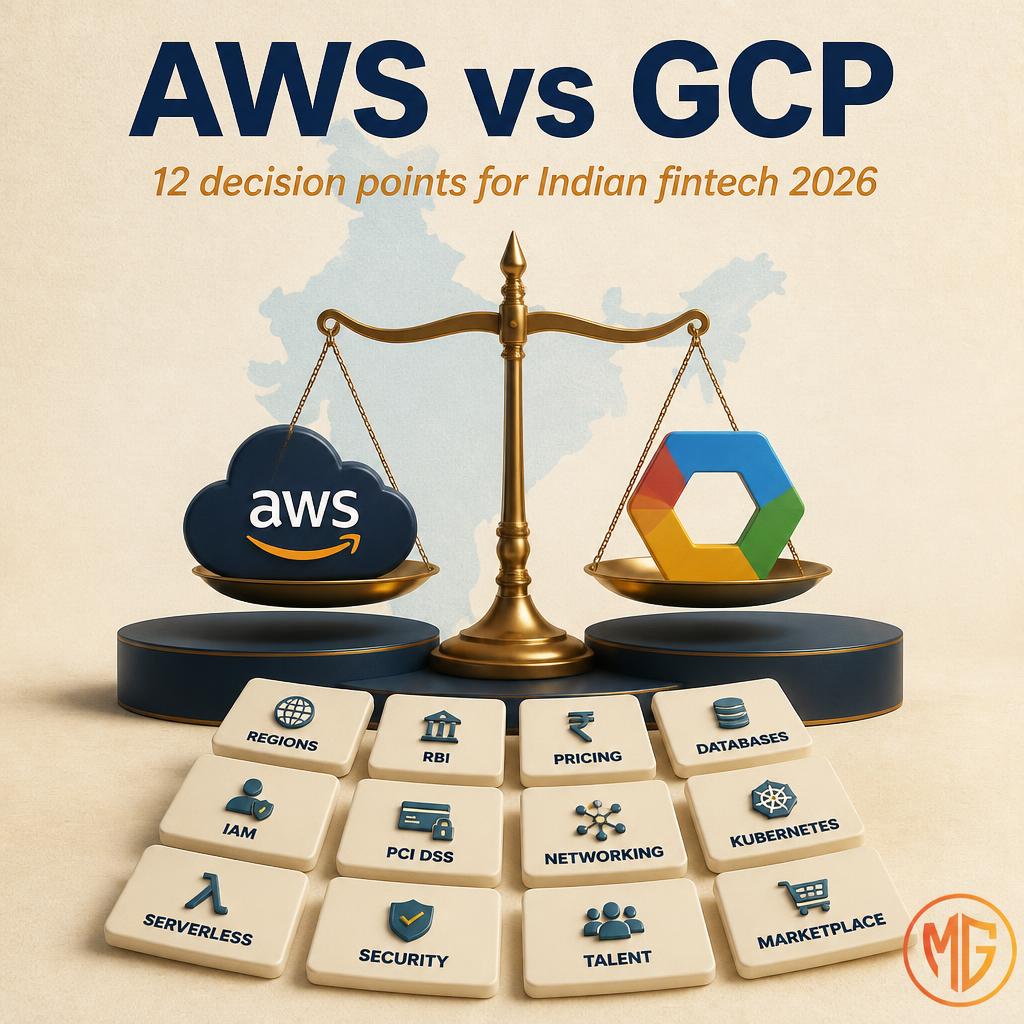
The standard AWS-vs-GCP comparisons online miss the realities that matter for an Indian fintech building in 2026. Most are written from a US-enterprise perspective. The factors that actually decide cloud choice for an RBI-regulated, India-incorporated fintech serving Indian users with a 5-50 person engineering team are different.
This is the breakdown across 12 decision points, with honest verdicts per factor. Both clouds are good. Neither is universally right. The right answer depends on which of these 12 you weight highest.
I have shipped production workloads on both AWS and GCP across most of the last decade, including India-region workloads with payment, KYC, and compliance scope. What follows is operational opinion grounded in that, plus public AWS, GCP, RBI, and MeitY documentation. Where I am stating opinion rather than fact, I have labelled it as such.
1. India region maturity and latency
AWS opened Mumbai (ap-south-1) in June 2016 and Hyderabad (ap-south-2) in November 2022. Three Availability Zones in Mumbai, three in Hyderabad. The Mumbai region carries almost every AWS service within months of US launch and has the densest CloudFront edge network in India (Mumbai, Chennai, Delhi, Hyderabad, Bengaluru, Kolkata).
GCP opened Mumbai (asia-south1) in November 2017 and Delhi (asia-south2) in July 2021. Three zones each. Service coverage has caught up substantially since 2022, though a handful of services (some newer Vertex AI features, certain Anthos add-ons) still lag the Mumbai region by 3-6 months versus US launch.
Verdict for Indian fintech: AWS wins on maturity, especially if you need active-active across two Indian regions for RBI Business Continuity Planning expectations. Hyderabad as a second AWS region is more mature than Delhi as a second GCP region today. Latency to users in Mumbai, Bengaluru, and Delhi is similar from both providers; the Tier-1 CDN tiers are comparable. The maturity gap closes another 30-50% per year, so by late 2026 this factor becomes near-neutral.
2. RBI Data Localisation and regulatory comfort
The relevant policies for Indian fintech are: RBI Storage of Payment System Data 2018 (payment data must be stored only in India), RBI Master Direction on Outsourcing of IT Services 2023, and the DPDP Act 2023 rules notification.
Both AWS and GCP are listed as eligible cloud service providers in MeitY's empanelment. Both publish RBI-aligned shared-responsibility models. Both offer India-resident customer data isolation, region-locked storage, and contractual commitments around regulator access. Both have walked through actual RBI bank inspections successfully via customers.
The operational difference is in how much paperwork the vendor already has signed for Indian regulators. AWS has had more Indian banks and NBFCs as customers for longer, which means standard MSAs already include RBI-acceptable clauses (data residency, audit rights, exit assistance, supervisory access). GCP has caught up, but for first-time RBI-regulated buyers the AWS legal package is more out-of-the-box.
Verdict: AWS, narrowly, on regulatory comfort. Once GCP has signed an MSA with you that includes the standard RBI clauses, the difference disappears. Plan an extra 2-4 weeks of legal review if you go GCP-first as a regulated Indian fintech.
3. Pricing for fintech-shaped workloads
The default pricing pages mislead. Indian fintech has a workload shape (compute + managed database + KMS + outbound bandwidth for webhooks + log retention) where the real cost lives in three line items: compute commit discounts, managed-database HA, and egress.
For equivalent on-demand compute (general-purpose VMs in Mumbai), GCP n2-standard pricing runs around 10-20% lower than AWS m6i in 2026, before any commit discount. With Committed Use Discounts (CUDs) of 1-year, GCP can drop another 30-35%. AWS Savings Plans (1-year, all-upfront) typically discount 35-50%. The math evens out at the upper commit tier; GCP wins at the no-commit floor.
Managed databases: Cloud SQL for PostgreSQL HA is about 15-25% cheaper than equivalent AWS RDS Multi-AZ for the same vCPU + memory + storage spec in Mumbai region. Aurora pricing is higher than both but you are buying a different engine architecture. Spanner, GCP's globally distributed SQL database, has no AWS equivalent at the same consistency tier (DynamoDB global tables are eventually consistent at the table level; Spanner is strongly consistent at the row level globally).
Egress bandwidth, the line item most fintech founders ignore until the bill arrives: AWS lists Mumbai egress at $0.1093 per GB up to 10 TB/month. GCP lists Mumbai egress at $0.12 per GB up to 1 TB/month, then $0.11 / $0.08 per GB at higher tiers. AWS's Reserved Instances do not reduce egress; GCP's commits do not either. For a webhook-heavy fintech (payment notifications, account updates, sync to external KYC providers) egress can be 15-30% of the monthly bill.
KMS: AWS KMS charges per key ($1/month per CMK) plus per request ($0.03 per 10,000 requests). GCP KMS charges $0.06 per active key version per month plus $0.03 per 10,000 operations. For a fintech with 50-200 CMKs (one per service per environment), KMS line item is comparable.
Verdict: GCP cheaper at the no-commit floor and for moderate workloads. AWS competitive at high commit tiers (3-year Savings Plans). Honest call: a single early-stage fintech burning ₹5-15 lakh/month on cloud will save 10-25% on GCP. Past ₹50 lakh/month, the gap closes or reverses depending on commit posture.
4. Database choices that matter for ledger systems
This is the factor where the two clouds diverge most for fintech. The choice is rarely simple.
AWS: Aurora PostgreSQL/MySQL is the workhorse for transactional workloads. Aurora Serverless v2 scales between 0.5 and 256 ACUs without read-replica downtime. DynamoDB for high-throughput key-value, with Global Tables for multi-region. RDS Proxy for connection pooling. Redshift for analytical workloads. The fintech-standard stack is: Aurora for ledger + DynamoDB for hot lookups + S3 + Athena for cold analytics.
GCP: Cloud SQL for PostgreSQL/MySQL is operationally simpler than RDS, but lacks Aurora's high-throughput storage architecture. Spanner is the unique GCP capability, globally distributed strongly-consistent SQL with five-nines SLA, but pricing starts around $0.90/node-hour minimum, so the floor for a non-toy Spanner instance is roughly $650/month. Firestore for document/key-value. BigQuery for analytics, the strongest analytical database on either cloud by significant margin.
For an Indian fintech building a ledger system that needs strong consistency at scale (think: settling cross-border remittances or running an in-house wallet), Spanner is genuinely a category-of-one product. AWS does not have a direct equivalent.
For a fintech building a simpler ledger + reads-heavy analytics workload, BigQuery beats Redshift on time-to-insight and price-per-query for ad-hoc fraud and risk queries.
Verdict: GCP wins on analytics (BigQuery) and globally-distributed SQL (Spanner). AWS wins on the operational maturity of Aurora and the depth of the surrounding ecosystem (RDS Proxy, Aurora Serverless v2 autoscaling). For most Indian fintechs at seed stage, Aurora is the safer default. For a fintech that will live or die on real-time analytics, GCP is the better long-term bet.
5. IAM, credential management, and secret rotation
This is the factor I have the strongest opinion on, having operationally maintained both.
AWS IAM is more powerful, more granular, and more complex than GCP IAM. SCPs at the Organizations level, permission boundaries, resource-based policies, and policy simulators give you control that GCP cannot match. AWS IAM Access Analyzer surfaces unintended external sharing more comprehensively than GCP's IAM Recommender.
GCP IAM is simpler, more opinionated, and frequently safer-by-default. The killer feature: Workload Identity Federation for GKE, which eliminates static service account keys for pods. Pods authenticate as Kubernetes service accounts; GCP IAM maps those to GCP service accounts; no JSON keys distributed, no secrets to rotate. AWS has IRSA (IAM Roles for Service Accounts on EKS) which achieves similar, but the GCP implementation requires less ceremony.
Secret management: AWS Secrets Manager is mature, integrates with Lambda, RDS auto-rotation, and CloudWatch Events for custom rotation hooks. GCP Secret Manager is simpler, with versioning baked in, but lacks the same depth of automated-rotation hooks.
Verdict: GCP wins on default-safety (Workload Identity, simpler IAM, fewer ways to misconfigure). AWS wins on advanced control surface (SCPs, permission boundaries, organization-level governance). For a startup with a 5-15 person engineering team that does not have a dedicated cloud security engineer, GCP's defaults reduce risk. For a fintech that needs fine-grained policy control across hundreds of accounts, AWS is more capable.
6. PCI DSS scope and shared-responsibility nuances
Both clouds carry PCI DSS 4.0 attestation. Both publish the Responsibility Matrix and the AOC (Attestation of Compliance) for download.
The operational difference: AWS marketplace has more PCI-scope tooling, log management, file integrity monitoring, vulnerability scanners, that integrates AWS-first. The major Indian compliance-automation platforms (Sprinto, Scrut, Drata, Vanta) all integrate AWS deeply; GCP integrations exist but cover fewer evidence sources. For a fintech going through a first PCI assessment, AWS reduces evidence-collection friction by 20-40%.
Specific PCI DSS 4.0 control areas where AWS has more out-of-box options: log retention with immutability (S3 Object Lock + S3 Glacier for 1-year retention), file integrity monitoring (CloudWatch + Inspector + third-party tools), and network segmentation (more granular Security Group + NACL options than GCP firewall rules).
Verdict: AWS for a first PCI DSS assessment. GCP is fully capable but you will spend more engineering time wiring up evidence collection.
7. Networking for payment-gateway connectivity patterns
Indian fintech needs hybrid connectivity to: bank partners (often via leased lines or MPLS), payment switches (Mindgate, AGS, FSS), KYC providers (Karza, Hyperverge, Signzy), and Aadhaar AUA/KUA infrastructure (UIDAI-mandated VPN tunnels). The cloud needs to support direct-connect to all of these.
AWS Direct Connect has more India-resident colocation partners (CtrlS, NTT, Sify, Reliance Jio) and more pre-existing private connectivity to NPCI, NSE, BSE, and major Indian banks. AWS Transit Gateway as the hub for multi-VPC + on-prem networking is more mature than GCP's equivalent (Network Connectivity Center + Cloud Router).
GCP's Shared VPC is simpler than AWS's account-per-environment VPC peering pattern, and is a genuine operational advantage at the 5-50 engineer scale.
For Aadhaar-bound workloads (eKYC, Aadhaar-linked payouts), both clouds have customers operating UIDAI-approved AUA/KUA architectures. AWS has more documented reference architectures published by Indian fintechs.
Verdict: AWS for hybrid connectivity to Indian banking infrastructure. GCP for cleaner internal networking when you do not need many partner connections.
8. Kubernetes: EKS vs GKE
This is the clearest verdict on the list. GKE wins.
GKE Autopilot mode runs the control plane and node infrastructure for you, billed per-pod. EKS requires you to either run nodes (more ops) or use Fargate (more cost). GKE upgrades, network policy, and HPA work out-of-the-box without the EKS-typical add-on installation ceremony (aws-load-balancer-controller, cluster-autoscaler, external-dns, kube-state-metrics, etc.).
GKE pricing for the managed control plane is comparable to EKS at $0.10/hour per cluster. The hidden cost difference is operational: a typical Indian fintech engineering team will spend 0.5-1 FTE-equivalent on EKS operational toil that simply does not exist on GKE Autopilot.
Verdict: GKE, unambiguously, for any Indian fintech that does not already have deep EKS operational expertise. The category-of-one product on GCP.
9. Serverless for India-specific bursty workloads
India has bursty traffic patterns that pure serverless suits well: NPS / TDS deadlines, IPL match windows, festival sale events, salary-day banking traffic.
AWS Lambda has the deepest ecosystem (custom runtimes, Lambda Layers, X-Ray integration, Step Functions for orchestration), the largest set of trigger sources, and the most mature observability tooling.
GCP Cloud Run is operationally simpler. Container-based, autoscale to zero, supports any runtime that builds to a container, billed per request + CPU-second. For a fintech that already builds Docker images for its services, Cloud Run is essentially "Lambda but you bring your own runtime, and the pricing model is cleaner." Cloud Run jobs and Cloud Run for Anthos add long-running and Kubernetes-bound variants.
Verdict: Cloud Run for simple HTTP-triggered services where you already have containerised builds. Lambda for event-driven workflows with rich AWS trigger graph (S3, DynamoDB Streams, SQS, EventBridge). Most Indian fintechs will use both eventually; pick by where the first 5 services need to live.
10. Security observability and threat detection
AWS approach: a stack of independent services. GuardDuty (threat detection), Security Hub (aggregation + CIS benchmark), AWS Config (configuration drift), AWS Inspector (vulnerability scanning), Macie (data classification), Detective (forensics), Audit Manager (compliance evidence). Each is good. Together, they are powerful but require integration effort.
GCP approach: Security Command Center as the unified pane. Bundled threat detection, vulnerability findings, sensitive-data discovery, posture management, and IAM Recommender all in one product. The Premium tier (required for most of the value) is expensive, but covers what AWS spreads across 5-7 separate services.
For a small fintech team (1-3 engineers responsible for cloud security), GCP's unified surface reduces operational fragmentation. For a larger team with a dedicated security engineer, AWS's specialised services give more depth per domain.
Verdict: GCP Security Command Center wins for small-team operational simplicity. AWS wins for advanced specialisation.
11. Indian talent availability
The hiring market is the factor most cloud-comparison articles ignore. For Indian fintech building in 2026, it is one of the most important.
AWS-certified engineers in India outnumber GCP-certified engineers roughly 5-7 to 1, based on public certification numbers, LinkedIn job posting data, and Naukri search ratios. AWS Solutions Architect is the most common cloud certification on Indian engineering resumes. GCP Professional Cloud Architect is rarer, and commands a 15-25% salary premium in 2026 because supply is constrained.
What this means operationally: if you build on AWS, you can hire mid-level cloud engineers from a pool of ~150,000 in India. If you build on GCP, the pool drops to ~25,000-40,000, and they are more expensive. For senior platform engineers (5+ years cloud-native), the gap narrows somewhat as senior engineers tend to be cloud-agnostic, but the rate premium for GCP senior is real.
The flip side: GCP engineers are often more recent (the certification programmes are newer), and the Indian GCP community runs a tighter set of regular meetups and conferences (GDG, Google Cloud Next India). The talent pool is small but higher-engagement on average.
Verdict: AWS for ease of hiring at mid-level. GCP for a smaller, more recent, more expensive pool. If your hiring runway is short, this factor alone may push you to AWS.
12. Marketplace and ecosystem
The AWS Marketplace has more compliance, security, and observability ISVs available with INR billing through Indian resellers. The major Indian compliance-automation platforms (Sprinto, Scrut, Drata, Vanta) integrate AWS first; GCP integrations exist but cover fewer evidence sources.
Indian managed-service-provider (MSP) ecosystem: AWS has the larger India MSP community by 3-4x. If you plan to outsource cloud operations to an Indian MSP (TCS, Infosys, Wipro, smaller specialists like Minfy, Searce, BluePi), AWS is the more common skill set.
GCP's marketplace has caught up substantially in 2024-2025 with the launch of GCP Marketplace India billing, but the depth of third-party offerings still trails AWS by roughly 2-3x in count.
Verdict: AWS for ecosystem depth and Indian MSP availability. GCP for native Google integrations (Workspace, BigQuery, Looker).
The honest summary table
| Decision factor | AWS | GCP | Lean |
|---|
| India region maturity | 3 regions, longer history | 2 regions, catching up | AWS |
| RBI regulatory comfort | More pre-signed MSA paperwork | Capable but newer for Indian regulated buyers | AWS |
| Pricing (no commit) | Higher floor | 10-20% cheaper floor | GCP |
| Pricing (3-year commit) | Aggressive Savings Plans | Strong CUDs | Roughly even |
| Ledger DB | Aurora, mature | Spanner, unique at scale | Depends on workload |
| Analytics DB | Redshift | BigQuery | GCP |
| IAM (default safety) | Powerful, complex | Simpler, safer defaults | GCP |
| IAM (advanced control) | SCPs, permission boundaries | Simpler, less granular | AWS |
| PCI DSS evidence collection | Deeper marketplace tooling | Fewer integrations | AWS |
| Hybrid connectivity (India banks) | More Direct Connect partners | Cleaner internal VPC model | AWS |
| Kubernetes | EKS, more ops | GKE Autopilot, less ops | GCP |
| Serverless | Lambda ecosystem | Cloud Run simplicity | Depends on workload |
| Security observability | Specialised, fragmented | Unified Security Command Center | GCP for small teams |
| Indian talent pool | 5-7x larger | Smaller, more expensive | AWS |
| Marketplace + MSP | Deeper | Newer, narrower | AWS |
The honest recommendation depending on your fintech stage
If you are a seed-stage Indian fintech with under 15 engineers and your first compliance gate is PCI DSS or RBI Master Direction: default to AWS. Lower legal friction, deeper ecosystem, easier hiring. The savings on GCP do not yet outweigh the operational overhead of a smaller talent pool and fewer integrations.
If you are a fintech where analytics and risk modelling are core differentiators: seriously consider GCP. BigQuery is enough of a category-of-one product that the rest of the trade-offs become acceptable.
If your engineering team has strong Kubernetes preferences and wants to spend zero time on cluster operations: GKE Autopilot makes GCP the better choice on day one, and the operational savings compound.
If you are building a globally-distributed ledger or a strong-consistency cross-region payment switch: Spanner is the right tool, and Spanner only exists on GCP.
If none of the above are decisive: AWS as default for Indian fintech in 2026, GCP for specific workloads where the unique capabilities (Spanner, BigQuery, GKE Autopilot) carry real weight.
The trap: defaulting to both
The mistake I see most often with Indian fintechs at the 30-50 engineer stage is "multi-cloud by accident." One team builds on AWS, another picks GCP for an analytics project, two years later the SRE team is maintaining two sets of IAM, two sets of networking, two sets of monitoring, two sets of compliance evidence. Cost increases roughly 1.6-1.8x for the same workload because the commit discount is split across two providers.
Pick one as primary. Use the other for one specific workload where the unique capability justifies the operational overhead. Resist the rest. Multi-cloud as a strategy is rarely a fit for a seed-stage Indian fintech; it is most often a sign that platform decisions were made by feature-team consensus rather than by an architect with the operational picture.
If you want a second opinion on your specific stack
I run a free 20-minute cloud audit for Indian fintech founders evaluating cloud choices. No NDA needed for the first conversation. Your specific workload, your specific compliance gates, my honest read on AWS vs GCP for your situation. Send a note.
Avinash S is the founder of MatrixGard. Fractional DevSecOps for early-stage startups, funded or bootstrapped across India, the GCC, the UK, and the US. Almost a decade of building, breaking, and securing cloud infrastructure on AWS and GCP across India and beyond.
Methodology note. Pricing references taken from public AWS and GCP pricing pages as of May 2026; numbers shift quarterly. Regulatory references taken from public RBI, MeitY, and IRDAI notifications. Operational opinions are mine, labelled inline. Where I have stated a verdict, the underlying tradeoffs are documented above; reasonable practitioners can weight them differently and arrive at the opposite call.